
Who decides the RTP of a slot
Three companies stand between a slot's mathematics and the screen a player sees, and each of them controls a different part of the published return. The studio designs the game and certifies one or more versions of it, a distribution platform delivers those versions to casinos, and the casino decides which version goes live in its lobby. Knowing which party controls which decision explains why the same title can show different figures from one site to the next.
The studio writes the mathematics
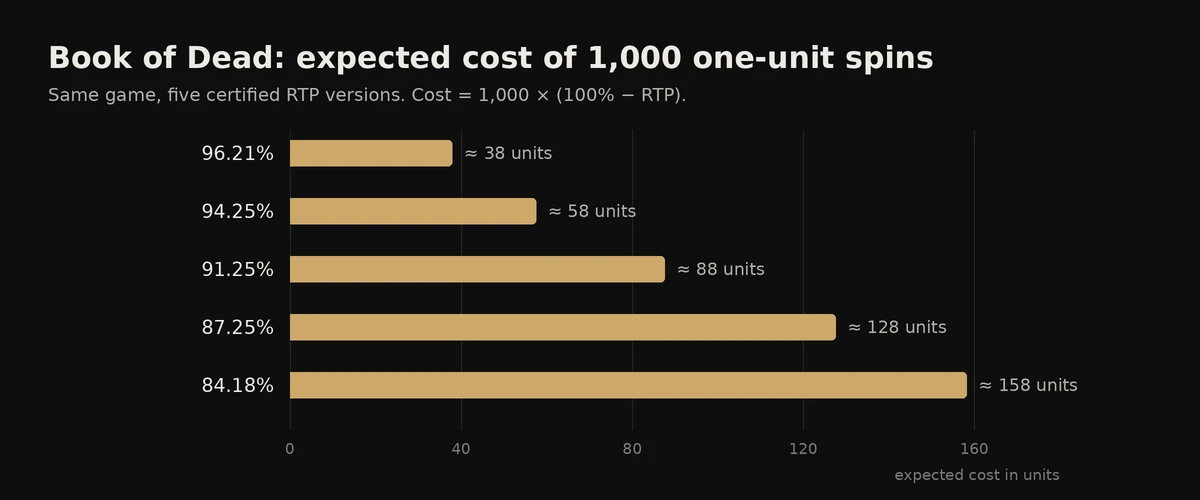
The developer builds the paytable, the symbol weights, the features and the random number generator, and it calculates the theoretical return that results from them. Many studios do not stop at one figure: they produce a set of configurations with the same graphics and rules but different returns, each tested and certified separately. Play'n GO is the clearest documented case in this index, with five return levels reported for Book of Dead, while Relax Gaming states that its titles are also supplied in reduced configurations alongside the standard one.
The aggregator delivers the game
Few casinos connect to every studio directly. Most take their content through aggregation platforms, which bundle hundreds of games from many developers behind one technical integration. Some studios run such platforms themselves: Relax Gaming develops its own titles and also distributes games from smaller partner studios. The platform passes the chosen configuration through to the casino but does not normally change the mathematics, which remain those certified by the developer and its testing laboratory.
The operator picks the RTP configuration
The final choice is made by the casino. When a studio offers several certified versions, the operator selects one, often to balance the cost of bonuses, marketing or local taxes against the return paid to players. Nothing on the game screen changes between versions, so the choice is invisible unless the rules panel is opened. This is why the figures listed by slot game providers are best read as the standard version, not a guarantee of what every casino runs, and why two sites can show different numbers for one title.
RTP configurations across slot game providers
The studios documented on this site differ in how openly they publish alternative versions and in which licences they declare. The table summarises four developers whose titles attract many searches about RTP, using the founding year, the licences each studio states publicly and the standard return of a documented game. A licence held by a studio covers the supply of its games, not the casino that runs them, which is a separate authorisation checked on the regulator's own register.
| Studio | Founded | Licences declared | Documented title and standard RTP |
|---|---|---|---|
| Play'n GO | 2005 | MGA, UKGC, SRIJ and more than 20 markets | Book of Dead, 96.21%, with four lower versions reported |
| Pragmatic Play | 2015 | MGA, UKGC, Curaçao and others | Wolf Gold, 96.01% |
| Relax Gaming | 2010 | MGA, UKGC, SRIJ | Money Train 3, 96.10% base and 96.50% on feature buys |
| Hacksaw Gaming | 2018 | MGA, UKGC, SRIJ | Wanted Dead or a Wild, 96.38% |
Two practical points follow from the table. A brand name and the licensed company behind it can differ, as with Pragmatic Play, whose British licence is held by Arrise Solutions (Malta) Limited, so a register search should use the company name. And a standard figure such as the Wolf Gold RTP of 96.01% is a starting point, to be compared with the number the game itself displays at a given casino.
How test houses certify a slot
Before a game can be offered in a regulated market, an independent laboratory checks that it behaves as its documentation says. The test house does not choose the return or judge whether the game is good value; it confirms that the random number generator is sound, that the rules are applied correctly and that each certified configuration produces the return stated for it. That certificate is what gives a published RTP its meaning in a regulated market.
What a test house checks
Testing covers the random number generator, the mapping of random values to symbols and outcomes, the paytable, the features and the long-run return of every version submitted. Laboratories typically combine a review of the mathematical model with simulations over a very large number of rounds, checking that the measured return settles close to the theoretical one. Each RTP configuration is a separate certified product, which is why a studio offering five versions of one slot submits five sets of results.
Approved test houses in Great Britain
The Gambling Commission publishes a list of approved test houses that licensees must use when its testing strategy requires third-party testing. In March 2026 the list included BMM Testlabs, eCOGRA, several Gaming Laboratories International (GLI) entities, Gaming Associates Europe, Global Lab, Eclipse Compliance Testing, Quinel and RiskCherry. Other regulators, such as the Malta Gaming Authority or the Isle of Man supervisor, keep their own lists, so a laboratory approved in one market is not automatically accepted in another.
What regulators require players to see
A certified return only helps a player who can find it, and the stricter regulators make disclosure a condition of the licence. The rules apply to the operator that offers the game, not only to the studio that built it, which is why the published figure in a game panel is the operator's responsibility to keep accurate. Requirements differ by country, but the British technical standards set out the principle clearly.
UK rules on RTP information
Under the Gambling Commission's remote technical standards, information on the house edge, the RTP or the probability of winning must be easily available before a customer commits to gamble, and the RTP should be the average theoretical return. The same standards require game rules, including any maximum win, to be explained before play. In practice this means a British player can open the information panel of any slot and find the active figure, a habit worth keeping in every market where it is offered:
- the theoretical RTP of the version currently loaded;
- the rules of every feature, including bonus buys and their own returns;
- the maximum win per round or per game cycle;
- any restriction on play, such as limits on stake or duration.
Where a game panel shows no return at all, that absence is informative, since a regulated operator is expected to make the figure available. Screenshots of the panel taken at the time of play are also the simplest record to keep if a question about the version in use ever arises later on, for example after a dispute with support.
Studio licences and casino licences are separate
A studio's supply licence covers the game, its mathematics and its delivery to platforms. The casino needs its own operating licence covering customer funds, complaints and safer gambling duties. A well-known developer appearing in a lobby therefore says nothing about whether the site itself is licensed where the player lives. The licensing and regulation guide explains how to check an operator on the regulator's public register in a few steps, using the company name rather than the brand.
Comparing slot game providers sensibly
Brand reputation is a weak guide to the cost of playing a particular game, because the same studio can supply versions with very different returns. A more useful comparison looks at what each provider publishes and how a given casino deploys it. The directory of slot game providers on this site lists founding years, declared licences and documented titles, and a few checks turn that information into a meaningful comparison:
- note the standard RTP the studio publishes for the game in question;
- find out whether the studio offers reduced configurations of the same title;
- open the game's information panel at the casino and compare the active figure;
- check the volatility and maximum win, which describe how the return is distributed;
- confirm that both the studio and the casino hold licences in the relevant market.
Applied to Book of Dead and its five RTP versions, these steps show that the difference between the top and bottom configuration matters more than any difference between studios. The same logic applies to the Money Train 3 RTP, where the bought feature is published at a higher return than the base game. The article on why one slot can carry several RTP versions explores that topic further, and the full slot RTP catalogue lists the standard figures for every documented title.