
Why one slot can carry several RTP settings
A slot is not a single fixed piece of mathematics. Many studios build each title with a set of alternative paytables and symbol weights, have every one of them certified, and then let each casino decide which one to switch on. The artwork, the features and the maximum win stay the same across all of them, so nothing on the screen reveals which mathematical version is running. Only the published return in the rules of the game shows the difference, which is why the same name can cost very different amounts at two sites.
Certified RTP versions chosen by the operator
When a studio supplies a game to an operator, it usually delivers a menu of approved configurations rather than one build. Each configuration has passed laboratory testing in its own right, so a reduced version is no less fair than the top one: it simply pays back less over time, mainly by making the larger wins rarer. The operator selects a version, sometimes market by market, and the choice can differ between two brands owned by the same group. Players see one game, while the accounting behind it can vary by several percentage points.
Why operators pick a lower setting
Lower configurations exist because they help operators cover costs that the player never sees directly: gaming taxes in some markets, the cost of bonuses and promotions, and fees paid to platforms and game aggregators. A casino that advertises large welcome offers may recover part of that spend through reduced versions of popular titles. None of this breaks any rule where configurations are certified and disclosed, but it means that the advertised headline figure for a game is only a ceiling, not a guarantee of what a particular site will run.
Book of Dead RTP versions in money
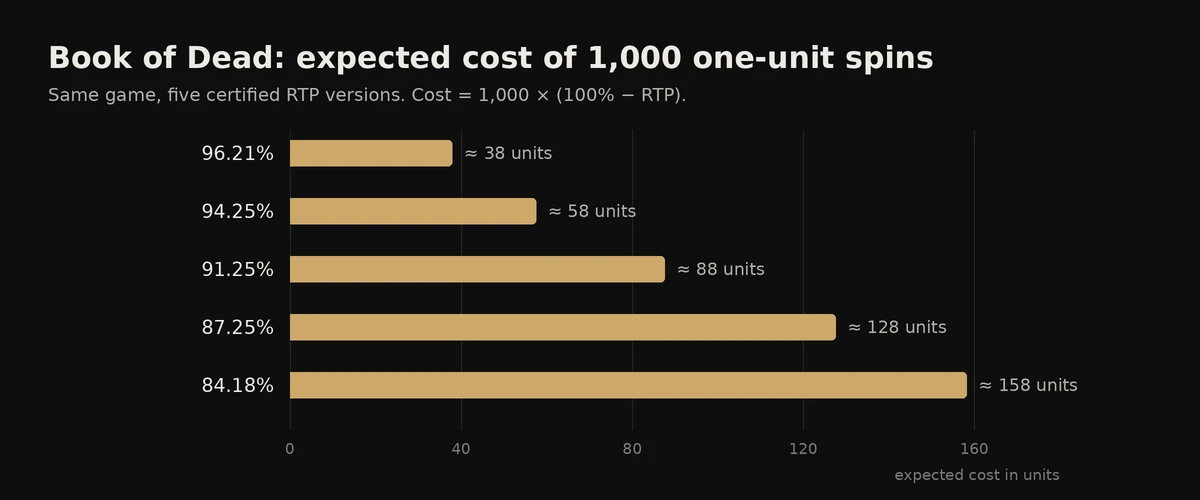
Book of Dead is the clearest case in this index because its studio, Play’n GO, has described certifying games at several return tiers, and five of them are reported for this title. Converting each tier into an expected cost shows how large the gap really is, and the image and table below set the five Book of Dead RTP versions side by side using 1,000 units staked as a common yardstick, roughly the volume of a long evening at modest stakes.
| Configuration | House edge | Expected cost per 1,000 units staked | Cost compared with the top tier |
|---|---|---|---|
| 96.21% | 3.79% | 37.9 units | 1.0 times |
| 94.25% | 5.75% | 57.5 units | about 1.5 times |
| 91.25% | 8.75% | 87.5 units | about 2.3 times |
| 87.25% | 12.75% | 127.5 units | about 3.4 times |
| 84.18% | 15.82% | 158.2 units | about 4.2 times |
The spread between the first and last rows is larger than the difference between almost any two separate slots in the catalogue. Choosing a different theme or provider rarely changes the expected cost by more than one or two points, while moving between configurations of the same game can change it by twelve. The Book of Dead RTP sheet explains the expanding symbol, the free spins and the 5,000x cap that sit on top of these numbers.
How to check the RTP version in the info panel
Every certified game states its theoretical return somewhere in its own help screens, and checking it takes less time than reading a bonus banner. The procedure is the same for slots from most studios, and it can usually be done in a demo version without an account. A short routine, repeated at each new site where a game is opened, removes most of the guesswork about which configuration is loaded:
- open the game and look for the menu, information or question mark icon near the spin button;
- select the game rules or help section rather than the paytable alone;
- scroll to the bottom, where the theoretical return to player is normally printed;
- note the exact figure and compare it with the developer's published maximum for that title;
- repeat the check after any major update, since an operator can switch configurations later.
If the figure matches the top published value, the session is running on the most favourable version available for that game. If it is several points lower, the same entertainment will cost noticeably more, and comparing the figure across sites becomes worthwhile before any money is staked, especially for a game that will be played often.
Reading the slot RTP on the rules screen
Some rules screens show a single number, while others list several, for example one return for the base game and another when a feature is bought directly. The relevant slot RTP is the one that matches how the game will actually be played, so a player who never buys features should read the base figure. A few studios also print a range rather than one value, in which case the lower end is the honest planning assumption, because the screen does not say which point in the range is active.
When the figure is missing or vague
A missing return is itself a piece of information. Regulated sites in Great Britain must make the figure available, and most reputable operators elsewhere display it in the same place, so a rules screen without any percentage, or with wording such as up to a certain value, deserves caution. In that situation the developer's documentation and the technical sheets in this index give the maximum, but they cannot confirm what the operator has chosen, and assuming the lowest known tier is the safer estimate.
What regulators require from published RTP
Rules on disclosure differ from one jurisdiction to another, and they explain why the same game may show its return clearly at one site and bury it at another. Regulators generally care that a game is certified and that players can find its return, rather than about which certified configuration an operator chooses. The detail matters for anyone comparing sites, because disclosure is what makes the comparison possible in the first place.
Great Britain and other regulated markets
In Great Britain, operators must make information about the return of each game available to players, and the figure is normally found in the help or rules screen of the game. Other licensing regimes with technical standards, such as those in several European markets, also require certified mathematics and testing by accredited laboratories. Within those rules an operator is free to choose any approved configuration, so disclosure protects the ability to check rather than guaranteeing the highest return.
Where disclosure is weaker
In markets with lighter supervision, the return may be omitted from the rules, described loosely, or shown only for the top configuration while a lower one runs. The licensing and regulation page of this index explains how different regulators approach testing and disclosure. Where a figure cannot be confirmed in the game itself, the practical conclusion is to treat the published maximum as a best case and to plan any session budget around a lower return than the headline suggests.
Other titles in the index worth checking
Book of Dead is the best documented example, but the habit of checking applies to every title. The technical sheets in this index list each developer's published figure, which gives a reference point to compare against the number shown in the game at a particular casino. The pages most often looked up for this purpose, and what each of them adds to the comparison, are these:
- the Book of Dead RTP versions sheet, with all five reported configurations;
- the Wolf Gold RTP sheet, published at 96.01% with medium volatility;
- the Wanted Dead or a Wild RTP sheet, published at 96.38% with very high volatility;
- the directory of slot game providers, which lists the licences and documentation of each studio.
When the figure in a game falls below the value on its sheet, the gap is not an error in the game but a sign of a reduced configuration, and the comparison above shows what that gap is likely to cost. A note of the date and the figure seen makes it easy to report a mismatch to the operator or to spot a later change of configuration.

Practical habits for comparing RTP versions
The simplest habit is to treat the return shown inside the game as the only figure that counts, and every other number, including the one on a review page or in this index, as the maximum it could be. Writing down the figure seen at each site takes seconds and makes it easy to notice if a version changes later. Over a year of regular play, sticking to sites that run the top configuration of familiar titles saves more than almost any other decision a player can make about the same games.
A higher configuration still loses money on average, only more slowly, so it is a way to make entertainment cheaper rather than a way to win. The general guide to what RTP means explains how to turn any figure into an expected cost, and combining that arithmetic with a fixed budget and a time limit is the most reliable way to keep play in proportion.