
What a bonus buy actually sells
A bonus buy, also called a feature buy, lets a player pay a fixed multiple of the stake to start a slot's bonus round straight away instead of waiting for the scatter symbols to land. The purchase does not create a new game. It skips the base game and goes directly to the part of the maths where most of the large wins are stored, which is why the price of the button and the return it carries deserve to be read as separately as two different products.
How the feature buy price is set
Studios price a feature buy close to the average value of the bonus round it triggers. If a free spins round pays back around 96 times the stake on average, a buy priced at 100x leaves the house its usual margin on that purchase. The price therefore reflects the long-run worth of the feature, not the chance of a big result. A round that usually pays very little and occasionally pays thousands of times the stake can still carry a price of 100x, because the rare outcomes are averaged into the figure that sets the cost.
Why the bonus buy RTP usually matches the base game
On most modern slots the published return for the buy is the same as the base game, or a fraction lower. Developers tend to keep the two equal so that buying neither rewards nor penalises the player in expected terms. Some studios publish a separate figure for each buy option, and on a handful of games that number differs from the headline. For that reason the info panel of each title is worth opening before the first purchase, because the bonus buy RTP is the only number that describes what the button really costs.
Money Train 3 RTP and its four feature buys
Money Train 3 from Relax Gaming is the clearest exception to the usual pattern in this index. The base game is published at 96.10%, while each of the four feature buys is listed at 96.50%. That makes it one of the rare titles where paying for the bonus carries a higher published return than spinning for it, a detail that explains why searches for the Money Train 3 RTP so often ask about the buy rather than the base game. The full figures sit on the Money Train 3 RTP sheet, and the purchase options compare as follows:
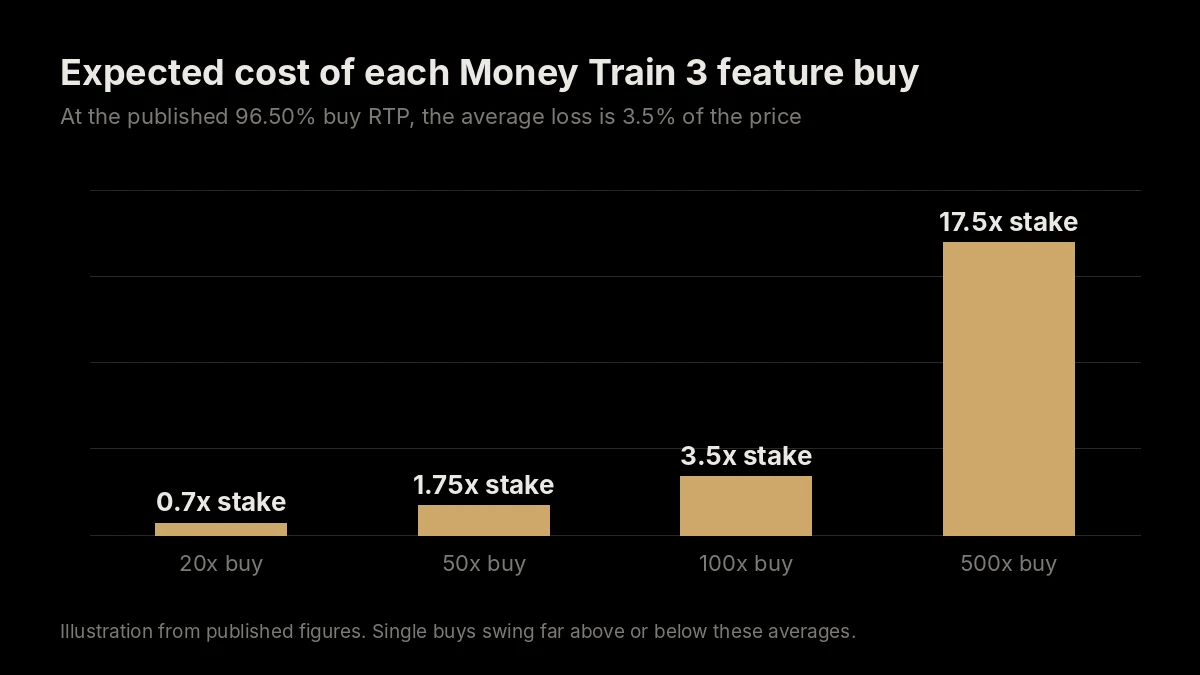
| Option | Price | Published RTP | Expected cost per purchase |
|---|---|---|---|
| Base game spin | 1x stake | 96.10% | 0.039x stake |
| Feature buy | 20x stake | 96.50% | 0.7x stake |
| Feature buy | 50x stake | 96.50% | 1.75x stake |
| Feature buy | 100x stake | 96.50% | 3.5x stake |
| Feature buy | 500x stake | 96.50% | 17.5x stake |
The expected cost column is simply the price multiplied by the house edge of 3.5%. It is an average over a very large number of purchases, and any single buy can return nothing at all or many times its price, which is exactly the range the feature is designed to produce, so the column describes a long run that no single session will resemble.
Expected cost per purchase
A 0.4 point gap between 96.10% and 96.50% sounds small, and per unit staked it is. On a 100x buy it means an average cost of 3.5x the stake instead of the 3.9x that the same amount would cost through ordinary spins. The saving is real but modest, and it only applies to the money that goes through the buy. A player who spends 1,000 units on 100x buys instead of 1,000 base spins saves about 4 units in expected terms while concentrating the whole amount into ten events instead of a thousand.
What the higher return does not change
The higher figure does not make a buy safer. A 500x purchase is a single event with very wide outcomes, and the 100,000x ceiling of the game is reached so rarely that it plays no practical part in a normal session. The published return also assumes the operator runs the standard configuration. Relax Gaming titles exist in reduced versions, so the base figure and the buy figure inside the game should both be read before relying on the numbers on any third-party page, including this one.
Wanted Dead or a Wild RTP and buying into high variance
Wanted Dead or a Wild from Hacksaw Gaming is listed in this index at 96.38% with very high volatility and a 12,500x ceiling, built around three separate bonus rounds called Dead, Wanted and Wild. Games of this type are where feature buys are used most heavily, because the base game can run for a long time without reaching any of the bonuses. The Wanted Dead or a Wild RTP page sets out the published data, and the game's own panel shows which buy options a given operator offers and the return attached to each one.
The practical lesson from a title like this is that a feature buy compresses volatility rather than removing it. The base game spreads its risk over hundreds of small stakes, while a purchase places a large stake on one round whose outcome can range from a small fraction of the price to a result hundreds of times larger. The expected return per unit is close to the same in both routes, but the path through a session looks completely different, and the purchase route reaches the end of a budget far sooner when results run below average.
Variance and bankroll when buying features
The expected return is only half of the picture when a feature buy is involved. The other half is how many attempts a budget allows, since each attempt costs dozens or hundreds of stakes at once. A modest bankroll that covers a thousand base spins may cover only ten 100x purchases, and the results of ten events are dominated by luck. The main differences between the two ways of reaching a bonus round can be summarised like this:
- base game spins spread the same budget over many small events, so results stay closer to the average;
- feature buys put large amounts on a few events, so the outcome of a session depends on very few results;
- the expected cost per unit staked is similar in both cases unless the studio publishes a different buy RTP;
- a run of poor bonus rounds after several purchases can use up a budget in minutes rather than hours.
None of these points changes the arithmetic of the game, but together they explain why players who buy features see far larger swings than those who spin through the base game with the same total budget, and why a buy session can end within minutes of starting even when every purchase was priced fairly against its average.
How many buys a budget covers
A simple test before using the button is to divide the session budget by the buy price. A budget of 2,000 units at a 1-unit stake covers twenty 100x buys or four 500x buys. With only four events, the chance that every one of them returns less than its price is substantial, because many bonus rounds in high variance slots pay well below their average. Comparing that number of attempts with the number of base spins the same budget would buy shows how much the purchase concentrates risk.
Max win caps and the buy
Feature buys are often promoted alongside the maximum win, but the cap describes the rare top of the distribution, not a target. On Money Train 3 the ceiling is 100,000x and on Wanted Dead or a Wild it is 12,500x, and in both cases the vast majority of bonus rounds finish far below those figures. The article on what max win caps really mean explains how ceilings are reached, and the guide to slot volatility versus RTP shows why two games with the same return can behave so differently.
Where bonus buys are not allowed
Feature buys are restricted in some regulated markets. In Great Britain the Gambling Commission told licensed operators in January 2020 to stop offering games with feature buy-ins to British customers, after finding six operators whose games let players pay to skip to bonus features, in some cases for up to £3,000 per purchase. The Commission said the functionality breached its technical standards. Where a market bans the option, the button is simply absent and only the base game configuration applies, so the buy RTP discussed above does not exist there.
Other jurisdictions apply their own limits on stake size, speed of play and game features, and operators remove or adjust options to fit them. A feature buy that appears on one site and not another is therefore usually a regulatory difference rather than a choice made by the studio, and the version of a game available in a given market is the only one whose figures matter to a player there.
Checking a feature buy before using it
A few minutes in the game's information screens answer most questions about a bonus buy before any money is committed. The figures can differ between operators and markets, so the check needs to be made on the version that will actually be played rather than on a demo elsewhere. A sensible order for that check is the following:
- open the paytable or game rules and find the published RTP for the base game;
- look for a separate RTP line for each feature buy option and note any difference;
- compare the buy price with the session budget to see how many attempts it allows;
- check the maximum win and whether any win cap applies per round or per day;
- confirm that the buy is available and permitted in the market where the game is played.
The broader slot RTP index lists the published return, volatility and ceiling for every game covered on this site, which makes it easy to see how a title with a bonus buy compares with similar games before deciding whether the feature is worth its price. Every figure there comes from the developer, and the in-game panel remains the final reference for any operator.