
How a max win cap works inside a slot
Every modern slot publishes a ceiling on what a single game round can pay, written as a multiple of the total stake. That figure is part of the game rules, set by the studio when the mathematics are designed and certified, and it is the same at every casino that runs the same version of the title. Reading it correctly means knowing two separate facts: what happens when a round reaches the ceiling, and how the ceiling turns into money at different stake sizes.
The round ends when the max win cap is reached
A max win cap is a hard stop rather than an estimate. When the running total of one round, including every free spin, respin and multiplier inside a bonus, climbs past the stated figure, the round is closed and the cap is paid. Any further spins that would have followed are not played. On Money Train 3, with its 100,000x max win, the rules state exactly this, which matters on a game whose persistent symbols keep multiplying across respins. The cap therefore removes the top end of the payout distribution instead of being a level the game aims for.
The cap scales with the stake
Because the ceiling is a multiple, its cash value depends entirely on the bet. A 5,000x cap is worth 500 at a stake of 0.10 and 25,000 at a stake of 5, while the chance of reaching it is identical at both sizes. Money Train 3 shows the range clearly: at its minimum stake of 0.10 the 100,000x cap pays 10,000, and at the maximum stake of 10 it pays 1,000,000. Raising the stake makes a capped round more valuable without making it any more likely, and it raises the cost of every ordinary spin by exactly the same proportion.
Max win caps compared across four slots
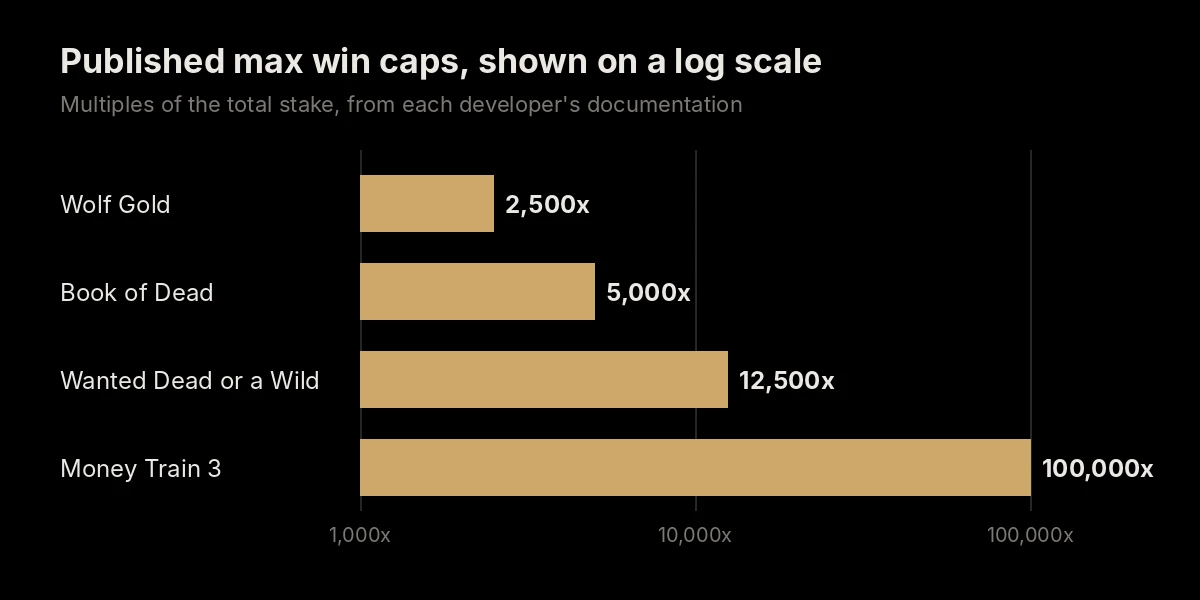
The four titles below are documented in this index and cover the full spread of ceilings found in current slots, from a medium-volatility classic to a game built around one of the highest caps on the market. The table pairs each max win with the published RTP and volatility rating, because the three figures only make sense together. The comparison uses the configuration each developer publishes as standard, and the game's own information panel remains the reference for the version an operator actually runs.
| Slot | Developer | Max win | Published RTP | Volatility |
|---|---|---|---|---|
| Wolf Gold | Pragmatic Play | 2,500x | 96.01% | medium |
| Book of Dead | Play'n GO | 5,000x | 96.21% | high |
| Wanted Dead or a Wild | Hacksaw Gaming | 12,500x | 96.38% | very high |
| Money Train 3 | Relax Gaming | 100,000x | 96.10% | very high |
The RTP column barely moves, staying within about 0.4 points across a forty-fold difference in ceilings. That is the central point of this article: the max win describes how the return is distributed between rare and frequent outcomes, not how large the return is. A higher ceiling does not mean a better game for the player, only a differently shaped one.
Why the max win cap follows volatility rather than RTP
A slot's return to player is a long-run average, while its volatility describes how unevenly that average is delivered. The max win sits at the far end of volatility. When a studio raises the ceiling, the extra value has to come from somewhere inside a fixed return, so it is taken from smaller and more frequent wins. That trade-off explains why the slot max win figure and the volatility label almost always move together across a catalogue.
A bigger max win usually means a lower hit rate
If two games both return about 96%, and one of them can pay 100,000x while the other stops at 2,500x, the first must deliver a meaningful share of its return through outcomes that almost never occur. Over a normal session, most players of such a game receive less than the published figure, while a very small number receive far more. Wolf Gold works the other way: its Mega jackpot is fixed at 1,000x and its cap at 2,500x, so more of its return arrives in ordinary line wins and free spins that land within a typical evening of play.
Where the RTP sits inside the paytable
The Money Train series shows how a studio can move value between the two ends. Money Train 2 was published at 98% with a 50,000x ceiling, while Money Train 3 doubled the ceiling to 100,000x and published 96.10%. The features grew, yet the total pot became smaller and more of it moved into rare outcomes. A higher max win cap in a sequel is therefore worth reading together with the RTP, because the headline ceiling can rise while the long-run return falls by almost two points, as it did here.

How rare a slot max win really is
Developers publish the ceiling but rarely the probability of reaching it, and that missing number is what turns a max win into a realistic or unrealistic expectation. Some studios state a hit frequency for the cap in their documentation; most do not. Where independent estimates exist, they consistently place full caps on high-volatility slots in the range of one in several million spins or rarer, far beyond the volume any individual player stakes.
Estimated odds and what they mean
On Book of Dead, the 5,000x maximum requires five expanded Rich Wilde symbols during free spins, and that outcome has been estimated at well under one in a million spins. Even at a pace of 600 spins an hour, one million spins would take more than 1,600 hours of continuous play. For a reader comparing the Book of Dead slot RTP and its 5,000x ceiling, the useful conclusion is that the cap describes the shape of the game, not a target that a session can be planned around or a budget can be set against.
Reported slot max win clips versus verified wins
Social media and streaming channels regularly show capped rounds, and several players reportedly reached the Money Train 3 cap shortly after its release. Studios generally do not publish verification of individual wins, so such clips cannot be used to estimate frequency. They are also selected after the fact: the thousands of sessions that ended far below the cap are never posted. A visible capped win says that the outcome is possible, which the rules already state, and nothing about how often it occurs.
Caps set by casinos and regulators
The studio's ceiling is not the only limit that can apply to a winning round. Casinos and regulators add their own rules on stakes and payouts, and these sit on top of the game's mathematics rather than replacing it. Before treating any max win figure as a possible payout, it helps to know which other limits may reduce it in practice:
- the developer's cap, expressed as a multiple of the stake and fixed in the certified game rules;
- an operator's cash limit per round or per day, written in the casino's general terms rather than in the game;
- a lower maximum win on rounds played with bonus funds, common in promotional terms;
- regulatory stake limits, such as the British limits of £5 per game cycle for adults aged 25 and over and £2 for those aged 18 to 24.
The British stake limits, in force since April and May 2025, show how much these layers change the arithmetic: at a £2 stake, a 12,500x cap on Wanted Dead or a Wild is worth £25,000, not the far larger figure quoted at the game's maximum stake elsewhere. The multiple stays the same; only the stake it multiplies has changed.
Reading a max win figure before playing
A max win figure is useful when it is read as a description of volatility and combined with the other published numbers. The casino game data index on this site lists the cap, RTP and volatility side by side for every documented title, and the same check can be carried out in the information panel of any game. A short routine turns the headline into something meaningful:
- find the max win in the game rules and note whether it is per round or per spin;
- check the active RTP in the same panel, since a reduced version keeps the same cap with a lower return;
- compare the volatility label, which predicts how rarely large wins arrive;
- look for bonus buy options, which change the cost of reaching the feature but not the ceiling;
- read the casino's terms for any separate cash limit on a single round.
Feature purchases deserve a separate look, because some studios publish a different return for bought rounds, as the article on bonus buy RTP and feature purchase costs explains. In every case, the cap remains a theoretical ceiling, and only money that can be lost without consequence belongs in a game whose value is concentrated at the very top.