
Volatility versus RTP in plain terms
Two numbers appear on almost every slot information panel, and they answer different questions. Return to player says how much of the money staked a game pays back on average over an enormous number of spins. Volatility says how that money is distributed between small frequent wins and rare large ones. Two slots can share almost the same return and still feel completely different to play, which is why reading one figure without the other gives an incomplete picture of any game.
What RTP measures
RTP is a long-run average calculated over millions of simulated rounds. A slot published at 96% returns 96 units for every 100 staked across that volume, which leaves the operator 4 units as its theoretical margin. The figure says nothing about the order in which wins arrive or how large they are, and it does not describe any single session. A deeper explanation of how the figure is produced, and why the same game can exist in several versions, is set out in the guide to what RTP means in slots.
What volatility measures
Volatility, sometimes called variance, describes how widely results spread around that average. A low or medium volatility slot pays small amounts often and rarely produces dramatic swings in either direction. A very high volatility slot keeps most of its return in rare features and large multipliers, so long runs of losing spins are normal and a single feature can be worth hundreds or thousands of times the stake. Developers publish their own labels, usually on a scale from low to very high, rather than a precise statistic.
Hit frequency and the shape of a session
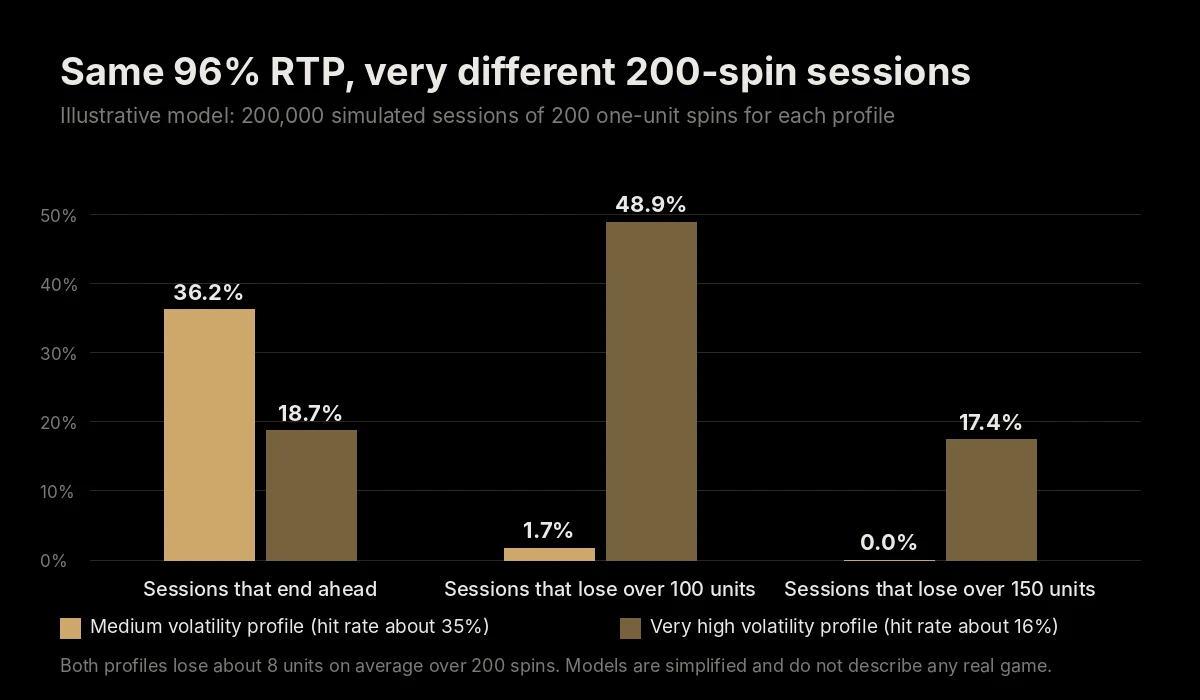
Hit frequency is the share of spins that return anything at all, including wins smaller than the stake. It is the most visible sign of volatility, because it decides how often a session pauses on a win. To show what this means in practice, a simple model was built with two slot profiles that both return exactly 96%, one with a hit rate of about 35% and one with about 16%, and each was played for 200,000 simulated sessions of 200 one-unit spins.
| Result after 200 spins | Medium profile | Very high profile |
|---|---|---|
| Theoretical return | 96% | 96% |
| Average loss | about 8 units | about 8 units |
| Median result | minus 21 units | minus 81 units |
| Sessions that end ahead | 36.2% | 18.7% |
| Sessions that lose over 100 units | 1.7% | 48.9% |
| Best 5% of sessions finish at least | plus 109 units | plus 834 units |
The two profiles are invented and simplified, so the figures describe the shape of the difference rather than any real game. Both lose the same 8 units on average, yet the typical session on the very high profile ends far deeper in the red, while a small minority of its sessions finish with results the medium profile almost never reaches.
Medium profile sessions
With roughly one spin in three paying something, a medium profile session rarely goes long without a win, and the balance drifts down slowly rather than falling in steps. More than a third of the simulated sessions ended ahead, and fewer than 2% lost more than half of a 200-unit budget. The cost of that steadiness is a low ceiling: the best sessions finished about 100 units up, and a result of several hundred units was practically absent from the model, because the large wins that would produce it were simply not part of the design.
Very high profile sessions
With only about one spin in six paying anything, the very high profile spends most of each session losing, and almost half of all simulated sessions lost more than 100 of their 200 units. The median result was a loss of 81 units, ten times the average loss. That gap exists because a small number of sessions hit a large feature and finished hundreds of units ahead, pulling the average up while leaving the typical outcome far below it. This is the pattern players describe as a slot being tight, and it follows directly from the design.
Wolf Gold, Money Train 3 and Wanted Dead or a Wild compared
Three slots indexed on this site show how real games sit on the volatility scale. Their published returns are within half a percentage point of each other, while their maximum wins range from 2,500x to 100,000x the stake. The table brings together the figures from each technical sheet, and the subsections below explain what the volatility label means for each of them in practice.
| Slot | Published RTP | Volatility | Maximum win | Expected cost per 1,000 units |
|---|---|---|---|---|
| Wolf Gold | 96.01% | medium | 2,500x | about 40 units |
| Money Train 3 | 96.10% | very high | 100,000x | about 39 units |
| Wanted Dead or a Wild | 96.38% | very high | 12,500x | about 36 units |
The expected cost column is simply the stake multiplied by the house edge, so it barely changes between the three games. What changes is the route to that cost, which is decided by slot volatility rather than by the published return, and that route is what a player actually experiences spin by spin and session by session.
Wolf Gold RTP with medium volatility
Wolf Gold, a 2017 Pragmatic Play slot, runs 25 fixed lines on a 5x3 grid with stacked symbols, free spins on a giant 3x3 reel and a Money Respin feature with three fixed jackpots, the largest worth 1,000 times the stake. Its Wolf Gold RTP of 96.01% is spread across many modest wins, and the 2,500x ceiling keeps the extremes in check. In terms of session shape it sits close to the medium profile above: frequent small returns, a slow decline over a long session and no realistic chance of a life-changing single result.
Money Train 3 RTP and very high volatility
Money Train 3 from Relax Gaming publishes 96.10% in the base game and a 100,000x cap, and most of its value sits inside the Money Cart bonus, a separate grid with more than a dozen interacting special symbols. A reported base game hit frequency of around one in five spins says little about its real character, because the outcomes that carry the return arrive rarely. The Money Train 3 RTP and volatility sheet also explains why its feature buys are published at 96.50%, a higher return on a much larger single stake.
Wanted Dead or a Wild and its three bonuses
Hacksaw Gaming's Wanted Dead or a Wild has the highest return of the three at 96.38%, yet it is labelled very high volatility alongside Money Train 3. It plays on a 5x5 grid with 10 lines and three separate bonus rounds, Dead, Wanted and Wild, with multiplier wilds that add together and a ceiling of 12,500x. The higher return does not make its sessions smoother; it only makes the long-run cost slightly lower, which is the clearest example on this list that the two figures measure different things.
How to read volatility labels
Volatility is rarely published as a number, and different studios use slightly different scales, so the label needs to be read together with the other figures on the information panel. A few signals point in the same direction for almost every slot and help to place a game on the scale even when the label is missing or vague. The most useful ones to check are these:
- the maximum win, since a ceiling of tens of thousands of times the stake almost always means very high volatility;
- the price of a feature buy, where one exists, because expensive buys signal that most of the return sits in the bonus;
- any published hit frequency, keeping in mind that it counts wins smaller than the stake;
- the paytable for ordinary symbols, which shows how much the base game can return on its own;
- the developer's own label, read on its own studio scale rather than compared across studios.
Taken together, these signals give a reliable sense of how a session is likely to feel and how long a fixed budget may last, which the published return alone cannot provide. The slot RTP index lists volatility labels next to every return for exactly that reason, so the two figures can always be read side by side.
Matching volatility to a session budget
The practical use of a volatility label is to set expectations before the first spin. A budget that would last a long, uneventful session on a medium slot can disappear in a fraction of the time on a very high volatility game, even though the average cost per spin is the same. A simple routine helps to keep the two in line and avoids the common mistake of judging a game by a few unlucky or lucky spins:
- decide the total amount for the session before opening any game;
- check the published return and volatility label in the game's info panel;
- choose a stake small enough to allow several hundred spins on a very high volatility slot;
- treat a long losing run on such a game as normal behaviour rather than a sign of a fault;
- stop when the budget is spent, regardless of how close a feature seems.
Following these steps does not change the expected result of play in any way, which remains a loss of a few percent of everything staked over time. It only keeps the variance of a chosen game from turning a planned session into an unplanned one, which matters most when slot volatility is labelled very high.
Why a higher RTP does not mean a smoother game
It is tempting to treat the return as a measure of how generous a slot feels, but the comparison above shows why that does not work. Wanted Dead or a Wild returns more than Wolf Gold and is far harsher to play. Money Train 3 returns slightly more than Wolf Gold and can go hundreds of spins without a meaningful win. Return describes the price of play over a very long run; volatility describes the experience on the way there, and players feel the second much more directly than the first.
The reverse is also true. A gentle medium volatility slot with a lower return can drain a budget more steadily than a very high volatility game with a higher one, simply because small regular losses add up without interruption. Neither figure predicts a session, and both are averages built on outcomes that the player cannot influence once the stake and the game are chosen.
Keeping slot sessions in proportion
Very high volatility games are designed around the rare large win, and the near misses and long dry runs that come with them can push a session well past its planned length. Choosing a fixed amount and a fixed time in advance, and accepting that most sessions on such games end in a loss, is the most reliable way to keep the experience under control. Slot play can become compulsive, and deposit limits, time-outs, self-exclusion and free helplines are collected on the responsible gambling page for anyone who wants support.