
What return to player means in plain terms
Return to player, almost always shortened to RTP, is the share of all money staked on a game that the game is designed to pay back over its lifetime. A slot published at 96% is built so that, across an enormous number of rounds, about 96 of every 100 units wagered flow back to players as wins, while the remaining 4 units stay with the operator. The figure describes the mathematics of the game as a whole, not the result that any one person will see tonight.
Theoretical return and house edge
RTP and house edge are two views of the same number. Subtracting the published return from 100% gives the edge, so a 96.21% slot carries a 3.79% house edge and a 99.29% blackjack table carries 0.71%. The edge is the more practical figure for planning, because it translates directly into the average cost of play: multiply the total amount staked by the edge and the result is what a session is expected to cost before luck is taken into account. A lower edge means a cheaper game on average, never a guaranteed profit.
RTP is measured over millions of rounds
Developers calculate the return from the full probability table of a game and confirm it by simulating very large numbers of rounds, often hundreds of millions, before a test laboratory certifies the result. Over a few hundred spins the actual payback can sit far above or far below the published figure, and that gap is not a malfunction. It is the normal behaviour of a random game in a small sample, which is why a single evening says almost nothing about whether a slot is performing to its specification.
Working out the cost of play from RTP
The most useful thing RTP does is turn an abstract percentage into an expected cost in money. The calculation needs only two inputs: how much will be staked in total across a session, counting every spin rather than the starting balance, and the house edge of the game. The chart below applies that arithmetic to 1,000 units staked at five return levels taken from games listed in this index, from a live blackjack table to a low configuration of a popular slot.
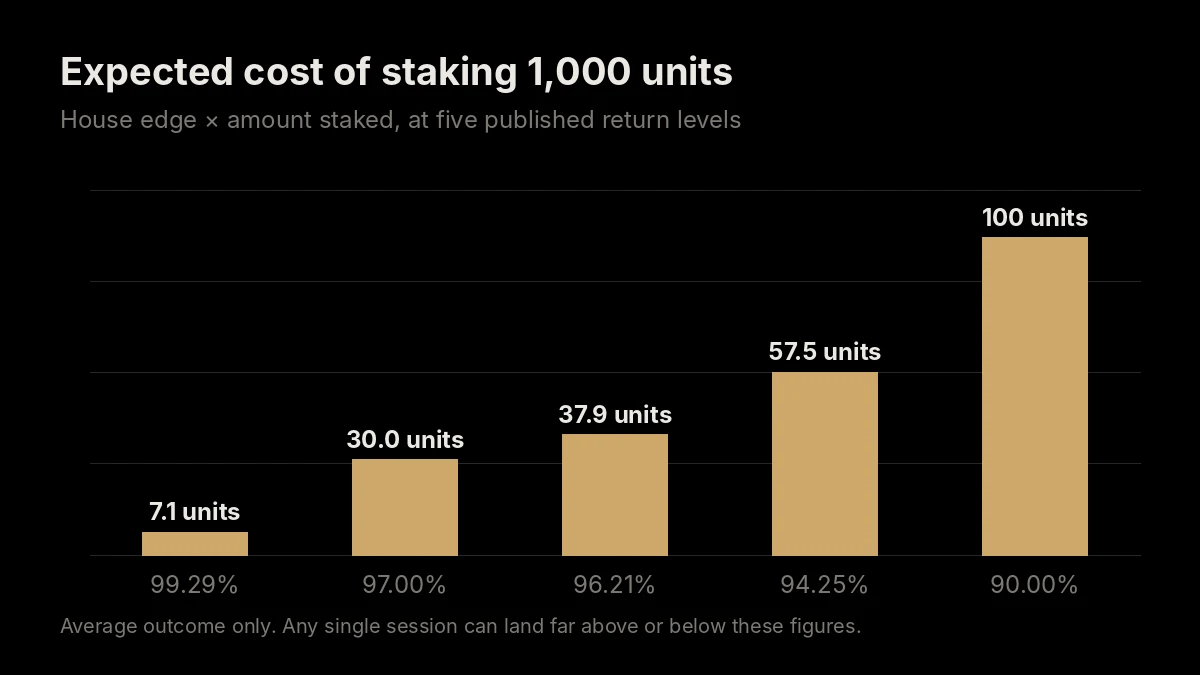
| Published RTP | House edge | Expected cost per 1,000 units staked | Example in this index |
|---|---|---|---|
| 99.29% | 0.71% | 7.1 units | Live Blackjack with basic strategy |
| 97.00% | 3.00% | 30 units | Aviator and Plinko |
| 96.21% | 3.79% | 37.9 units | Book of Dead, top configuration |
| 96.01% | 3.99% | 39.9 units | Wolf Gold |
| 94.25% | 5.75% | 57.5 units | Book of Dead, second configuration |
Turning these figures into a session estimate takes four short steps, and the same method works for slots, crash games and table games alike, since each of them publishes a return in its rules. The order matters, because most people underestimate the second step, which is the one that decides the size of the result:
- find the published RTP in the game's information panel and subtract it from 100% to get the house edge;
- estimate the total amount staked by multiplying the stake per round by the number of rounds planned;
- multiply that total by the house edge to get the expected cost of the session;
- compare the expected cost with the budget set aside for entertainment before the first round.
A player who spins 500 times at 2 units on a 96% slot stakes 1,000 units and should expect to lose about 40 of them on average, even though the starting balance might have been only 100 units. The amount recycled through the game, not the deposit, is what the edge works on, which is why fast games with a modest edge can still cost more per hour than slow games with a larger one.
Slot RTP, hit rate and volatility are different numbers
Three figures describe how a slot behaves, and they are easy to confuse because all of them relate to winning. RTP says how much comes back in total. Hit rate says how often a spin returns anything at all. Volatility describes how unevenly the returns are spread, from frequent small amounts to rare large ones. Two games with an identical slot RTP can feel completely different to play, and only the combination of all three numbers explains why.
Hit rate and how often a slot pays
Hit rate, sometimes called hit frequency, is the proportion of spins that produce a win of any size. A slot might hit on one spin in three, yet many of those wins are smaller than the stake, so the balance still falls. A high hit rate can make a game feel generous while its return stays exactly where the developer set it. Not every studio publishes hit frequency, and when it is missing the paytable and the volatility rating give a rough sense of how the wins are distributed across a session.
Volatility and the spread of results
Volatility measures how far individual sessions drift from the average. A medium-volatility title pays more evenly, as the Wolf Gold RTP sheet shows with 96.01% and a 2,500x cap, while a very high volatility game like Money Train 3 concentrates much of its return in rare bonus rounds with a far higher ceiling. Both lose money on average at a similar rate, but the high-volatility game produces longer losing runs and a small chance of a very large win. The article on slot volatility and RTP covers this trade-off in more depth.
Where RTP figures come from
A published return is not an estimate made by players or review sites. It is calculated by the studio that designs the game and checked by an accredited test laboratory before the game can be offered in regulated markets. The editorial methodology of this index takes every figure from developer documentation for that reason, and it flags cases where the version running at a casino may differ. The chain from design to screen has four links, and each of them can be checked:
- the game studio sets the paytable and symbol weights that produce the theoretical return;
- an independent laboratory tests the mathematics and the random number generator before release;
- regulators in markets such as Great Britain require the return to be available to players;
- the game's own information panel shows the figure for the configuration actually loaded.
The last link is the one that matters at the moment of play, because a studio may certify the same title at several return levels and leave the choice to each operator. The article on slot RTP versions explains how those configurations work and how to spot a lower one before staking anything, using nothing more than the rules screen of the game.
Typical RTP ranges across game types
Return levels cluster differently by category, and knowing the usual range helps a figure stand out when it is unusually high or low. The examples below come from the technical sheets in the online slots RTP index and its sister sections, so every number can be traced to a page on this site that names the developer and the mechanics behind it.
Slot RTP in the catalogue
Most modern video slots in this index publish returns between about 95% and 97%. Cleopatra from IGT sits at 95.02%, Book of Dead at 96.21% in its top configuration, and Immortal Romance at 96.86%. A one-point difference sounds small, yet across 10,000 units staked it changes the expected cost by about 100 units. The Book of Dead RTP sheet shows how the same game can also run several points lower when an operator selects a reduced version, with nothing on the reels to show the difference.
Crash and instant games
Crash and instant games usually publish higher returns than slots, commonly around 97%. Aviator, JetX, Mines and Plinko all list 97.00%, Spaceman 96.50% and Chicken Road 98.00%. The catch is speed: rounds take seconds, so the total amount staked per hour grows quickly and a small edge can add up to a larger hourly cost than a slow slot. Several of these games let players adjust risk levels, which changes the spread of results without moving the return, so a lower risk setting is not a cheaper way to play.
Live and table games
Live dealer games span the widest range. Blackjack played with correct basic strategy reaches 99.29% on the table listed here, Lightning Roulette publishes 97.30%, and game shows such as Crazy Time run up to 96.08% depending on the bet spot. In table games the return can depend on decisions, so a player who ignores basic strategy at blackjack gives up part of that advantage. The headline figure assumes the best play the rules allow, and side bets on the same table usually carry a much larger edge than the main hand.
Common misreadings of slot RTP
The most widespread mistake is reading RTP as a promise about a single session, as if a 96% slot should return 96 units from every 100 deposited tonight. It does not, and it cannot, because the figure is an average over a sample far larger than any player will ever reach. A related error is the belief that a slot which has not paid for a while is due to pay, when each spin is independent and the random number generator has no memory of previous results.
Another misreading treats a higher return as a reason to play longer. A better RTP lowers the cost per unit staked, but staking more units still raises the total expected loss, so a high-return game is a cheaper form of entertainment rather than a way to earn. The figures on the Best Online Slots home page and in each sheet are meant for comparing games, and they work best alongside a fixed budget and a time limit decided in advance.