
Why live casino RTP varies so much between games
Every game in a live lobby is streamed from a studio with real dealers, cards, wheels and balls, yet the theoretical returns behind those streams differ by several percentage points. A classic card table built on fixed rules sits near the top of the range, while a game show with bonus rounds and random multipliers sits lower. The table below brings together the published figures from the live casino sheets on this site, all of them games from the same studio, Evolution.
| Game | Published RTP | Volatility | Maximum win |
|---|---|---|---|
| Live Blackjack | 99.29% | low | depends on hand |
| Lightning Roulette | 97.30% (97.10% straight up) | medium | 500x |
| Dream Catcher | 96.58% | medium | 40x |
| MONOPOLY Big Baller | 96.10% | medium | 10,000x |
| Crazy Time | up to 96.08% | high | 25,000x reported |
The pattern is easy to see once the columns are read together. The larger the possible single win, the lower the published return tends to be, because money that pays for rare, very large outcomes has to come from somewhere. The full live casino RTP index keeps the same figures alongside each game's rules, and the chart below shows how far apart the best and worst bets in this group really are.
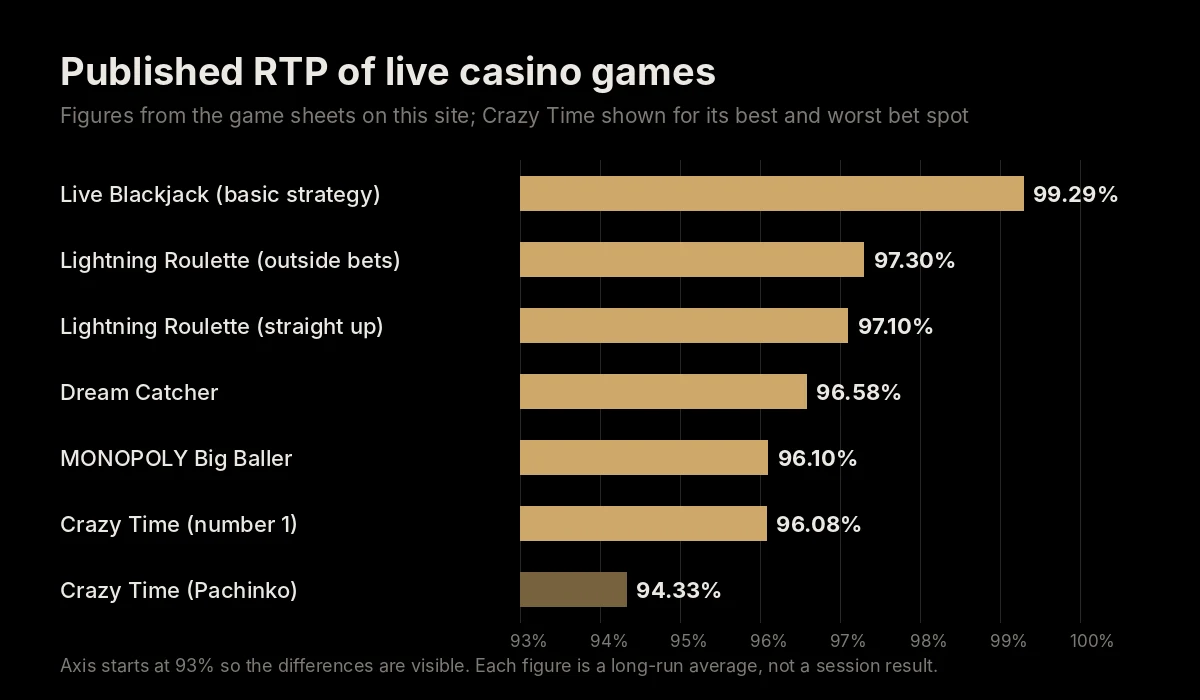
Live blackjack RTP and the cost of decisions
Blackjack is the only game in this group where the player's own choices decide how much of the theoretical return is actually received. The 99.29% figure published for Evolution's live table is the result of perfect play, which means standing, hitting, doubling and splitting exactly as the mathematics of the remaining cards suggests. The detailed live blackjack RTP sheet lists the rules behind it, including the dealer standing on 17 at most tables.
Basic strategy as the condition behind 99.29%
Basic strategy is a fixed table that gives the best decision for every combination of the player's hand and the dealer's visible card. Followed on every hand, it leaves the house an edge of about 0.71% on this table, so 1,000 units staked over a session cost around 7 units on average. Each departure from the chart, such as standing on a soft 17 against a strong dealer card or refusing to split eights, adds a small cost, and a handful of habitual errors can double or triple the effective edge without the player noticing anything unusual about the results.
Side bets and Bet Behind at the live blackjack table
Live tables add optional side bets that pay for pairs, three-card combinations with the dealer's card or other patterns, and these carry a markedly worse return than the main hand. A player who adds a side bet to every hand is effectively mixing a 99.29% game with a much cheaper one, and the blended return falls accordingly. Bet Behind, which lets someone stake on a seated player's hand when the seats are full, keeps the main game's mathematics but hands every decision to a stranger, so its real return depends on how well that stranger plays.
Lightning Roulette and multiplier funding
Lightning Roulette is a useful example of how a studio adds excitement without adding money. The wheel is the standard single-zero European wheel with 37 pockets, and between one and five numbers per round receive random multipliers of 50x to 500x. Those multipliers are paid for by a lower base payout on straight-up bets, which is why the game publishes two different returns depending on where the chips are placed on the layout.
Straight-up bets at 97.10%
A straight-up win pays 29:1 here instead of the usual 35:1. On its own, that payout returns only about 81% of the stake over 37 pockets, and the multipliers lift the long-run figure to 97.10%. The practical consequence is that the return on single numbers is concentrated in rare multiplier hits. A long session in which none of a player's numbers is struck by lightning is not unusual bad luck; it is the lower base part of the game running exactly as designed, and the average only reassembles itself over a very large number of rounds.
Outside bets at the standard European rate
Bets that can never receive a multiplier, such as red or black, odd or even, dozens, columns, splits and corners, pay their normal amounts and return 97.30%, the same as ordinary European roulette with one zero. For anyone who places mostly outside bets, the lightning layer changes the presentation but not the price. The Lightning Roulette sheet sets out the full arithmetic, including why some sources quote the straight-up payout as 29:1 and others as 30x for exactly the same outcome.
Game shows and the price of big moments
Wheel and bingo shows are built around rare bonus rounds with large multipliers, presented by a host for an audience of thousands at once. That format sells excitement rather than value, and the published returns reflect it: the main game shows in this group sit between about 94% and 96.6%, several points below blackjack. The gap is not hidden, but it is spread across many bet spots and bonus rules, which makes it harder to see at a glance than on a card table.
Crazy Time RTP by bet spot
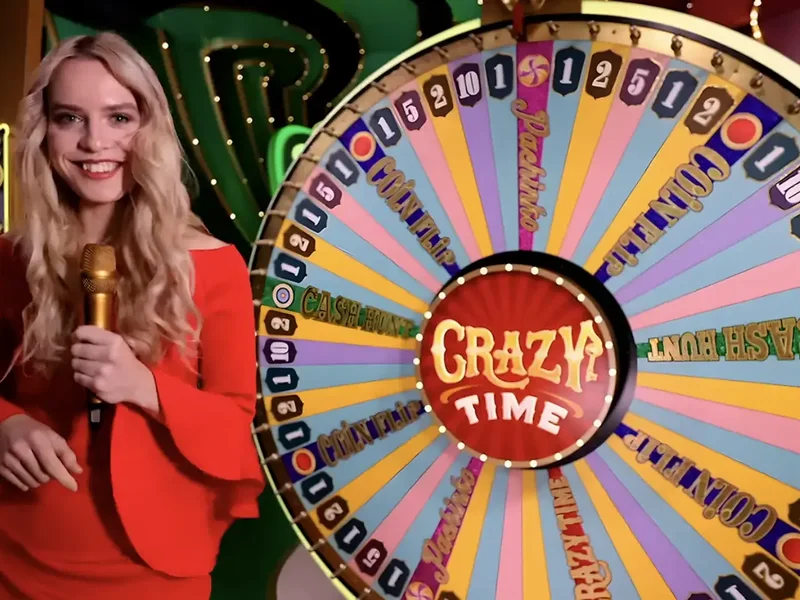
Crazy Time has no single return. Each of its eight bet spots carries its own figure, from 96.08% on the number 1 down to 94.33% on Pachinko, with the headline Crazy Time bonus at 94.41%. The often quoted figure belongs to the best spot only. Over 1,000 units staked, the number 1 costs about 39 units on average and Pachinko about 57, so the choice of spot matters more than any timing or pattern. The Crazy Time RTP sheet lists every spot and explains how the Top Slot multipliers are funded.
MONOPOLY Big Baller and bingo-style shows
MONOPOLY Big Baller combines a 5x5 bingo card, twenty drawn balls and a three-dimensional board round, with a published return of 96.10% and a maximum win of 10,000x. Buying more cards raises the total stake per round but does not change the return on each unit staked, and neither does the choice of cards. The format feels slower than a wheel because each round has several stages, yet the expected cost per unit is close to that of the best Crazy Time spot and well above that of blackjack played with basic strategy.
How bet choice changes the live casino RTP
Because so many live games publish more than one figure, the headline number on a lobby tile is rarely the one that applies to a particular player. The figure that matters is the one attached to the exact bet being placed, and finding it takes a minute inside the game. A simple routine works for every title in this group and keeps the comparison honest:
- open the game's help or rules panel before the first round;
- find the return listed for each bet type or bet spot rather than the overall figure;
- note which bets can receive multipliers and which cannot;
- check whether side bets are listed separately and at what return;
- compare the figure for the intended bet with the alternatives on the same table.
Done once per game, this check usually shows that the cheapest option on a table is a plain bet without multipliers, and that the most expensive is a side bet or a bonus spot chosen for its excitement. The difference rarely appears on the lobby tile, so the rules panel remains the place to look, and the figure found there is worth writing down for later comparison.
A few general patterns also hold across the live catalogue. They are not a substitute for the rules panel, because individual variants can break them, but they are a useful shortcut when there is no time to read a full rules page before sitting down at a table, and they apply to cards, wheels and bingo shows alike:
- bets that can win a multiplier are usually priced lower than bets that cannot;
- side bets nearly always return less than the main bet they accompany;
- bonus spots on wheel shows return less than the plain number spots;
- games that depend on decisions only reach their published figure with correct play.
None of these patterns makes any bet profitable over time, since every figure in this article is below 100%. They only show where the cost of the same amount of play is lower or higher, which is the one comparison a published return can actually support. They say nothing about what any single round or evening will bring.
Studio figures versus the operator's table
The returns quoted here are the figures published for the standard versions of each game. Studios can supply variants with different rules, side bets or paytables, and table rules such as the number of decks or the dealer's action on soft 17 change the blackjack figure directly. An operator also chooses table limits, which do not change the return on each unit staked but do change how quickly a balance moves. For that reason the help panel inside the game, rather than a third-party table, is the final reference for the version being played, and a figure that differs from the published one is worth noticing before staking anything.
Live games also run at a slower pace than random number generator games, with a fixed betting window, a physical deal or spin and a pause for settlement. Fewer rounds per hour means fewer units staked per hour at the same bet size, which lowers the hourly cost even when the return is identical. That is one reason why a live game with a modest return can cost less over an evening than a fast automated game with a higher one.
Keeping live casino sessions in proportion
A host, a chat window and other players at the same table make live sessions feel social, and that atmosphere can stretch a session well beyond its planned length. Setting a fixed amount and a fixed end time before joining a table, and skipping side bets and bonus spots that only add cost, keeps the experience closer to what the published figures describe. Gambling can be addictive, and anyone who finds it hard to stop can use the tools and support services listed on the responsible gambling page. For a closer look at the card game itself, the guide to blackjack RTP at live dealer tables covers rules and decisions in more depth.