Crazy Time
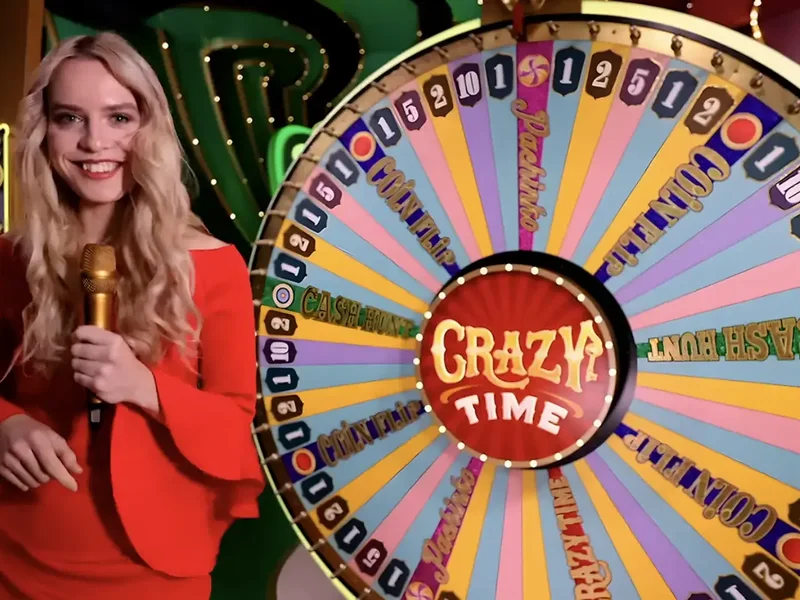
A presenter-led money wheel with 54 segments, a Top Slot multiplier before every spin and four bonus games, each priced at its own return.
 By Arjun Mehta · Mobile Casino & Gaming Technology Writer
Technical sheet
| Developer | Evolution |
|---|---|
| Release year | 2020 |
| Category | Live casino |
| Theme | Game show |
How Crazy Time works
- A vertical money wheel with 54 segments: 21 × 1, 13 × 2, 7 × 5, 4 × 10, 4 Coin Flip, 2 Cash Hunt, 2 Pachinko and 1 Crazy Time;
- Number segments pay 1:1, 2:1, 5:1 and 10:1;
- A two-reel Top Slot pairs one bet spot with a random multiplier before each spin;
- Four bonus games are entered only by players with a stake on that bonus spot.
Both the Top Slot result and the wheel result are random, and the presenter’s spin has no skill element that a bet can follow. The only decision the player makes is where to place the stake, and that choice alone sets the theoretical return of the bet, from about 96.08% on the number 1 down to about 94.33% on Pachinko.
How Crazy Time compares
| Game | RTP | Volatility | Max win |
|---|---|---|---|
| Crazy Time (this page) | 96.08% | high | 25,000x |
| Lightning Roulette | 97.30% | medium | 500x |
| MONOPOLY Big Baller | 96.10% | medium | 10,000x |
| Dream Catcher | 96.58% | medium | 40x |
| Live Blackjack | 99.29% | low | depends on hand |
This is not a recommendation
We publish technical data, not playing advice. RTP values come from the developer's documentation; an operator may deploy a different configuration, so check the figure inside the game's own info panel. Gambling can be addictive — only ever stake money you can afford to lose.
Crazy Time RTP belongs to the bet spot, not the game
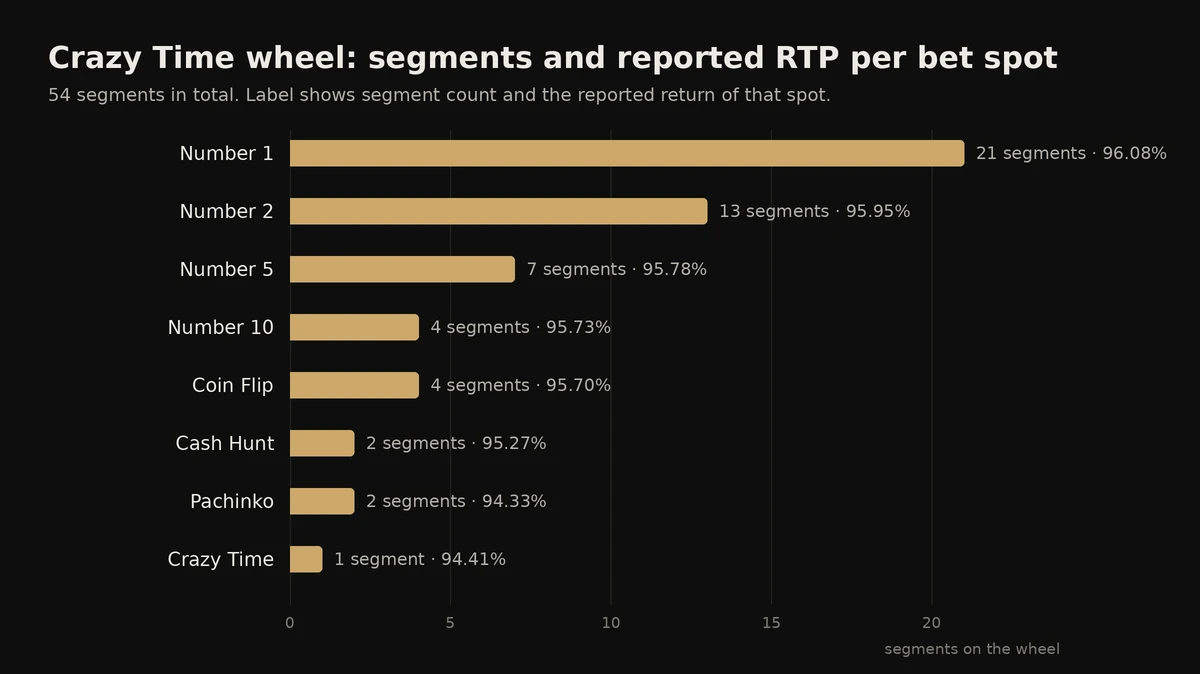
Crazy Time does not have one RTP. Each of the eight places where a stake can go carries its own theoretical return, and the 96.08% quoted in most comparison tables, including the one above, belongs to the most common segment on the wheel, the number 1. The figures below are the per-spot returns widely reported for the game; Evolution’s own help files could not be consulted for this sheet, so the in-game rules screen remains the reference for the version an operator runs. When people quote a single Crazy Time RTP, they are quoting the best spot on the wheel and leaving out the seven others.
Number segments
The four number spots are the steadiest part of the game. The number 1 is reported at 96.08%, the number 2 at 95.95%, the number 5 at 95.78% and the number 10 at 95.73%. They pay 1:1, 2:1, 5:1 and 10:1 respectively, plus any Top Slot multiplier that lands on them, and together they occupy 45 of the 54 segments of the wheel. A player who only ever backs the number 1 is playing the best-priced version of Crazy Time, with an expected cost of about 3.92% of the amount staked. The higher numbers pay more per win but land less often, and their returns are slightly lower because more of their value depends on the Top Slot.
Bonus segments
The four bonus spots are priced lower. Coin Flip is reported at 95.70%, Cash Hunt at 95.27%, the Crazy Time bonus at 94.41% and Pachinko at 94.33%, which makes Pachinko, not the headline bonus, the lowest figure in the game. The difference between the best and the worst spot is 1.75 points, which sounds small but means that the same session staked on Pachinko instead of the number 1 costs almost half as much again in expected terms. The bonus spots are where the show’s biggest moments come from, and their lower pricing is the cost of that excitement.
Where the Top Slot money comes from
As in Lightning Roulette, the multipliers are not a gift added on top of the game: they are funded by base payouts that are lower than the wheel would justify on its own. The Top Slot is what makes a 1:1 payout on a segment that covers only 21 of 54 positions add up to a return above 96%. A round follows a fixed order that makes this easy to see:
- bets close and the Top Slot spins, pairing one bet spot with a random multiplier;
- the main wheel is spun by the presenter and stops on one of 54 segments;
- if the result matches the Top Slot spot, the payout or the bonus is multiplied;
- on a bonus segment, players with a stake on that spot enter the bonus game.
Without the Top Slot, the number 1 would return 21/54 × 2, or about 77.78%; the number 2 about 72.22%; the number 5 about 77.78%; and the number 10 about 81.48%. The published figures sit between 14 and 24 points higher, and that gap is exactly what the Top Slot multipliers pay back over a very long run. A session in which the Top Slot keeps missing your spot is therefore not bad luck against a 96% game; it is the 72–81% part of the game running on its own, as designed.
The four bonus games
Bonus segments are rare by design, and that rarity is what lets them carry large multipliers. Coin Flip occupies four of the 54 segments, so it comes up about once every 13.5 spins on average; Cash Hunt and Pachinko occupy two each, about once every 27 spins; and the Crazy Time segment appears once on the wheel, so it lands on average once every 54 spins. Rules differ slightly between markets, as the Pennsylvania regulations show, so the description below follows the version most players will see.
Coin Flip
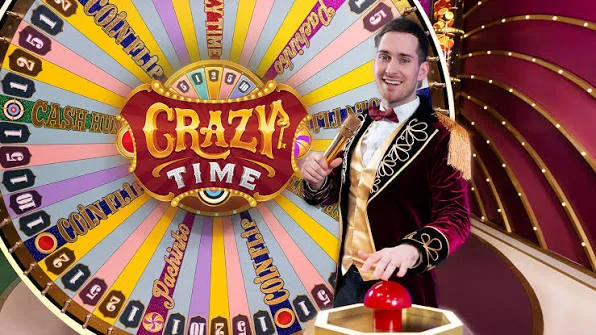
Two multipliers are drawn, one for the red side and one for the blue side of a coin, and the presenter flips it. The player receives the multiplier of the side that lands face up. It is the most frequent and the least volatile bonus, because the outcome is always one of two values that are both visible before the flip, and its reported return of 95.70% is close to the number spots. A Top Slot multiplier on Coin Flip multiplies both values before the flip, which is the main route to a large result in this bonus.
Cash Hunt
A wall of 108 hidden multipliers is shown, the symbols are shuffled, and each player picks a target. Every participant chooses independently, so two players in the same round can receive very different results. Evolution has reported a 25,000x win on Cash Hunt, the largest documented outcome in the game, but the median result is far smaller, and the choice of target has no effect on the expected value. Because results differ between players, screenshots of huge Cash Hunt wins say little about what a typical participant received in the same round.
Pachinko
A puck is dropped down a wall of pegs and lands in one of sixteen slots at the bottom, each with a multiplier. A DOUBLE slot doubles every value on the board and sends the puck down again, which is how the round can reach very high multipliers. It is the lowest-priced spot in the game, at a reported 94.33%, because so much of its value is concentrated in rare chains of doubles. Most drops land on an ordinary multiplier and end the round straight away, which is why Pachinko feels generous in highlights and much less so over a long session.
The Crazy Time bonus
The presenter walks through a red door to a giant vertical wheel with 64 segments. Each player picks one of three flappers, blue, green or yellow, and receives the multiplier their flapper points to; DOUBLE segments double every value and spin the wheel again. Some versions also include TRIPLE segments, which the Pennsylvania rules do not list, so the exact wheel depends on the jurisdiction. The bonus is the most famous part of the show and, at a reported 94.41%, one of the most expensive to chase.
Why betting every spot costs more
The most common Crazy Time strategy is to cover all eight spots so that every bonus is caught when it lands. It feels like a way to stay in the game and never miss the big moment, but the arithmetic works against it, because each unit placed on a bonus spot is priced lower than a unit placed on the number 1, and the total stake per round rises eightfold.
The cost of covering the wheel
One unit on each of the eight spots stakes eight units per round, and the average of the eight reported returns is about 95.41%. The expected cost is therefore around 4.59% of the amount staked, against 3.92% when the same total goes on the number 1 alone. Over 200 rounds at eight units, that is roughly 73.5 units of expected cost instead of 62.7, and the result is much more volatile, since most of the value sits in rare bonus rounds. Covering the wheel does not protect a budget; it spends it faster at a slightly worse price.
How long a bonus can take
Frequencies on a wheel are averages, not schedules. With one segment out of 54, the chance that the Crazy Time bonus does not appear at all in 54 spins is about 36%, and in 100 spins it is still around 15%. Long gaps are an ordinary part of the game, not a sign that a bonus is “due”, and staking more after a long gap does not change the odds of the next spin. Each spin is independent, so the wheel has no memory of the last time the bonus appeared, and a planned budget should allow for gaps far longer than the average.
Frequently asked questions
What is the Crazy Time RTP?
It depends on the bet spot. The figures widely reported for the game range from 96.08% on the number 1 to 94.33% on Pachinko, with the Crazy Time bonus at 94.41%.
What is the maximum win in Crazy Time?
Evolution has reported a 25,000x win on Cash Hunt. Many operators also apply a cash cap per round, often quoted at €500,000, which could not be confirmed from an official source.
How often does the Crazy Time bonus land?
The segment appears once on a 54-segment wheel, so about once every 54 spins on average, with long gaps being normal.
Does the Top Slot make the game better value?
No. The Top Slot multipliers are already included in the published returns, and they are funded by base payouts that are lower than the wheel alone would justify.