
Why blackjack RTP depends on the player
Most casino games have a return that the player cannot influence: a slot pays what its maths dictates whatever button is pressed. Blackjack is different, because the player makes decisions on every hand, and each decision either matches the mathematically correct play or gives value away. The blackjack RTP printed in a game's help screen is therefore a conditional figure. It describes the return a player receives only when every hit, stand, double and split follows the best available choice for that exact set of rules.
What basic strategy is
Basic strategy is the set of decisions that maximises the expected return for each combination of player total and dealer up-card, calculated by computer simulation over millions of hands. It is usually printed as a chart: stand on hard 17 and above, always split aces and eights, never split tens, double on 11 against most dealer cards, and so on. It does not involve counting cards or remembering previous hands. It is simply the best move for the cards currently on the table, and it changes slightly whenever the table rules change.
How much mistakes cost
Players who rely on hunches typically give away far more than the house edge itself. Common errors such as standing on 12 against a dealer 2 or 3, refusing to double 11, or splitting tens each lower the expected return of that hand, and over a session they add up. Simulation studies regularly put the cost of casual, intuition-based play at one to two percentage points or more, which can turn a game advertised close to 99.3% into one that behaves like an ordinary slot in practice, whatever the table limits or the dealer.
How table rules move the house edge
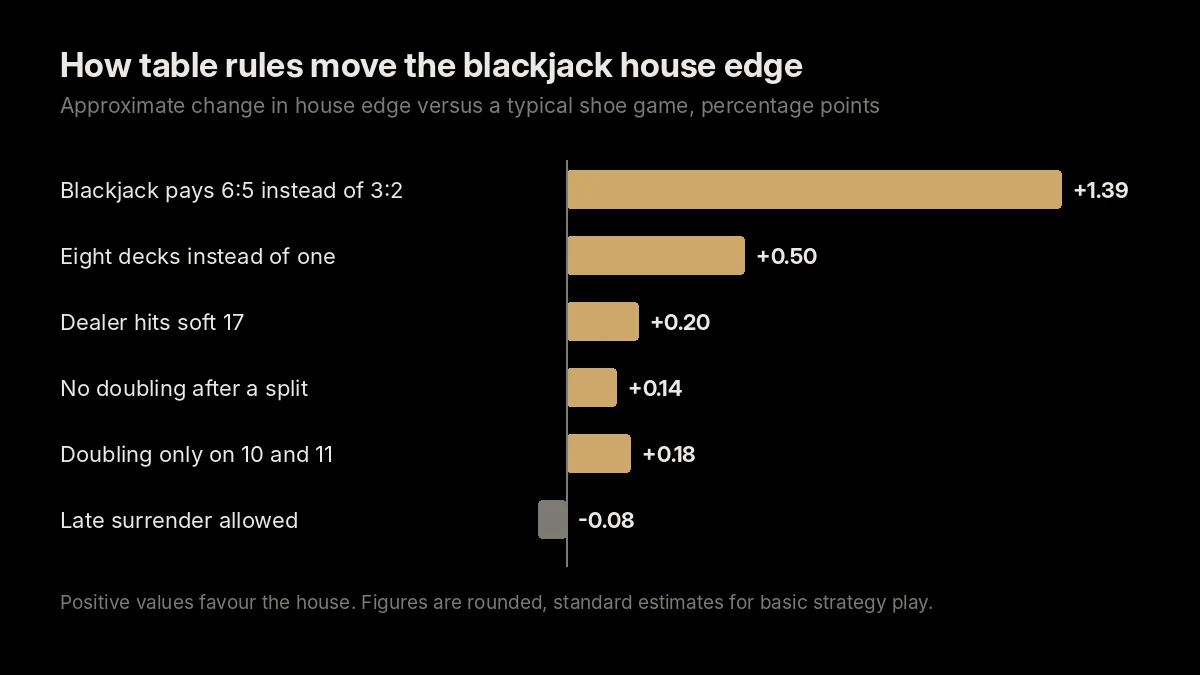
Blackjack is not one game but a family of rule sets, and small changes in the rules shift the house edge by measurable amounts. Analysts have estimated the effect of each rule against a standard shoe game for decades, and the figures below are widely used approximations. They are additive for practical purposes, which means a table with several unfavourable rules can cost several times more than a table with good ones.
| Rule change | Approximate effect on house edge | Direction |
|---|---|---|
| Blackjack pays 6:5 instead of 3:2 | about 1.4 percentage points | Worse for the player |
| Eight decks instead of one | about 0.5 percentage points | Worse for the player |
| Dealer hits soft 17 | about 0.2 percentage points | Worse for the player |
| Doubling allowed only on 10 and 11 | about 0.18 percentage points | Worse for the player |
| No doubling after a split | about 0.14 percentage points | Worse for the player |
| Late surrender allowed | about 0.08 percentage points | Better for the player |
The six to five payout is the rule to spot first
A natural blackjack arrives in roughly one hand in twenty-one. Paying it at 6:5 instead of 3:2 cuts that payout from 1.5 times the stake to 1.2 times, and because naturals are so frequent the cost lands at around 1.4 percentage points, more than all the other common rule variations combined. A 6:5 table can therefore have a house edge near 2%, roughly three or four times that of a good 3:2 game, even though the difference is printed in small type on the felt or the help screen, where few players look before the first hand.
Soft 17, decks and doubling
When the dealer must hit a soft 17, such as ace and six, the dealer improves more often, which costs the player about 0.2 points. More decks make blackjacks and favourable doubles slightly less likely, so an eight-deck shoe is around half a point worse than a single deck. Restrictions on doubling and on doubling after a split each remove a profitable option and add a little more. None of these is large on its own, but together they explain why two blackjack tables can publish quite different returns.
Live dealer blackjack RTP in practice
Live dealer tables stream a real dealer and a physical shoe, so the game follows ordinary card-room rules rather than a software algorithm. The live dealer blackjack RTP listed on this site for Evolution's standard tables is 99.29%, which corresponds to a house edge of about 0.71% with correct basic strategy. That is among the highest published returns in any casino category, but it is also the figure most often misunderstood.
Rules on a typical live table
Rules published by a gaming regulator for one live blackjack product describe a common format: eight decks, the dealer standing on all 17s, blackjack paid at 3:2, splitting limited to two hands, split aces receiving one card each, and insurance offered when the dealer shows an ace. Those rules explain the 99.29% figure. A slightly higher return would need more player-friendly options such as resplitting or surrender, and a lower one would follow from hitting soft 17 or restricting doubles.
Bet Behind at live dealer blackjack tables
A live table has a limited number of seats, usually seven, so live formats add Bet Behind, which lets extra players stake on the hand of a seated player. The person betting behind makes no decisions of their own; they inherit the choices of the seated player. If that player follows basic strategy, the Bet Behind return is close to the main game; if the seated player makes poor decisions, the return for everyone betting on that hand falls with them, which is a cost that no help screen can display.
Side bets and insurance
Optional wagers are where most of the difference between advertised and achieved blackjack returns comes from. They pay large multiples for specific card combinations, which makes them attractive, but they are priced with a much bigger house edge than the main game. Before placing any optional wager at a live table, it is worth reviewing the following points in the game rules:
- the published return of each side bet, usually listed separately from the main game in the help screen;
- the paytable for Perfect Pairs and 21+3, since operators can choose between versions with different returns;
- whether insurance is offered and how it is settled when the dealer has blackjack;
- the maximum stake for side bets compared with the main wager.
Optional wagers of this kind commonly publish returns in the mid-90s per cent range, several points below the main game, so a player who adds them to every hand turns a game that costs less than 1% of the stake into one with a much higher blended cost. The large multiples on the paytable are how that difference is hidden.
Why insurance is a poor bet
Insurance pays 2:1 if the dealer, showing an ace, has a ten-value card underneath. In an eight-deck shoe, roughly 30.8% of the unseen cards are tens, so the bet wins about 31 times in 100 and loses about 69. Paying 2:1 on those odds returns about 92.5 units per 100 staked, a house edge of roughly 7.4%. Taking even money on a natural is the same bet in a different form, and basic strategy declines both for a player who is not counting cards, however strong the player hand looks at the time.
How a side bet changes the session cost
Suppose a player stakes 10 units on the main hand and 2 units on a side bet with a 4% edge, for 60 hands an hour. The main hand costs about 0.71% of 600 units, or roughly 4.3 units an hour, while the side bet costs about 4% of 120 units, or 4.8 units. The small side wager costs more than the main game despite being a fifth of the size, which is the arithmetic behind the advice to treat these optional wagers as entertainment priced well above the table itself, and to keep their stake small if they are used at all.
Checking the return before sitting down
Every live blackjack variant publishes its rules and return in the game's information panel, and the check takes about a minute before the first chip is placed. Following the same short sequence at every table makes different products easy to compare and prevents an unfavourable rule from going unnoticed:
- open the help or rules screen inside the game window;
- confirm that a natural blackjack pays 3:2 rather than 6:5;
- check whether the dealer stands or hits on soft 17;
- note the published return for the main game and for each side bet;
- compare the figures with other tables listed in the lobby.
A table that passes these checks still keeps a margin, and the published figure applies only to perfect basic strategy. The live casino RTP index lists the published figures for each live title on this site, and the Evolution studio profile covers the company that supplies the tables discussed here.
Blackjack beside other live games
Compared with other live titles, blackjack offers the lowest built-in cost, but only to players who learn the strategy. Game shows such as Crazy Time and multiplier roulette publish returns between about 96% and 97.3%, and none of them depends on decisions. That makes blackjack the one live game in which the player's own play is the biggest variable in the return actually received, for better or worse.
The comparison of live casino game returns sets those figures side by side. Whatever the game, a session budget fixed in advance and a stop rule that does not change after a losing hand keep the house edge working within planned limits, because even a 0.71% edge adds up over hundreds of hands, and no strategy turns blackjack into a game with a positive expected return.