

What the 97% Plinko RTP actually describes
Spribe publishes a return to player of 97% for its Plinko, and that single figure applies to every board size and every risk colour the game offers. It is a long-run average across a very large number of drops: for each 100 units staked, the game is designed to hand back about 97 and keep about 3. Nothing in the figure says how any one ball will land, and nothing in it changes when a player switches from a calm board to an aggressive one, which is the point most explanations of the RTP Plinko players search for tend to miss.
How the multiplier table is built around the return
Each combination of rows and risk level has its own row of multipliers printed under the board. Those numbers are not chosen for looks. The studio sets them so that, when every slot multiplier is weighted by the probability of the ball reaching that slot and the results are added together, the total comes to 0.97. A red board on sixteen rows and a green board on twelve rows look completely different, yet both pass that same arithmetic test, which is why the published figure can stay fixed while the shape of the payouts changes dramatically.
Why the bounce animation does not matter
The ball appears to ricochet off the pegs, but the landing slot is decided by the random number generator before the animation starts, as the Spribe Plinko RTP sheet on this site explains. The drawing on screen simply illustrates a result that already exists. That has a practical consequence: there is no skill in timing a release, no advantage in watching previous balls, and no pattern that a player can learn from the way the pegs seem to deflect the ball. Every drop is an independent event with the same odds as the one before it.
Rows, pegs and the binomial distribution
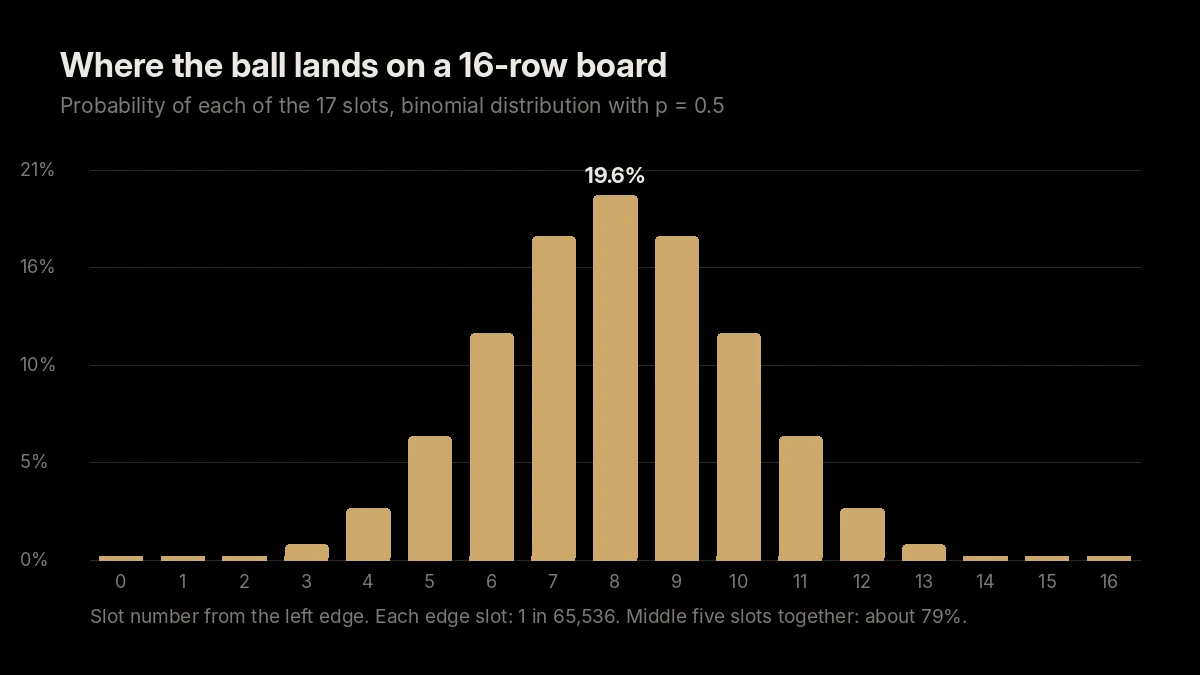
The mathematics behind the board is older than any casino game. At each row of pegs the ball goes either left or right with equal probability, so the final slot depends only on how many of those individual steps went to the right. That is a textbook binomial distribution, and it explains why the centre of the board is crowded with low multipliers while the large figures sit at the far edges, where the ball almost never arrives.
How the edge slots become so rare
To land in the leftmost slot, the ball has to go left at every single row. On a board with n rows that happens with probability one half raised to the power n. With twelve rows the chance is 1 in 4,096 for each edge, with fourteen rows it is 1 in 16,384, and with sixteen rows it falls to 1 in 65,536. Adding rows does not just add a few more slots; it pushes the extreme outcomes much further away, which is exactly what allows the game to print bigger numbers on the edges of larger boards without changing the overall return.
Where most balls actually finish
On a sixteen-row board the single middle slot collects about 19.6% of all drops, and the five slots around the centre together collect roughly 79%. In other words, about four balls out of five end up in the zone where multipliers are smallest, often below the stake. The chart above makes the shape plain: a tall peak in the middle and long, almost empty tails. Knowing that distribution is more useful than any multiplier label, because it shows where the money usually goes on an ordinary drop.
Risk colours change the spread, not the return
Spribe's version offers three risk levels shown as ball colours, green, yellow and red, alongside a choice of 12, 14 or 16 rows according to game data listings. Choosing a colour redistributes the same 97% between the slots. Green keeps the multipliers close together, so results swing gently, while red strips value from the middle slots and loads it onto the edges, so most drops pay little or nothing and rare drops pay a lot.
| Rows | Green range | Yellow range | Red range |
|---|---|---|---|
| 12 | 0.5x to 11x | 0.3x to 25x | 0x to 141x |
| 14 | 0.5x to 18x | 0.2x to 55x | 0x to 353x |
| 16 | 0.4x to 35x | 0.2x to 118x | 0x to 555x |
What the red risk level feels like in play
The 555x figure on a sixteen-row red board sits in a slot the ball reaches about once in 65,536 drops on that side, while the middle slots on the same board can return nothing at all. A player who chooses red is therefore accepting long runs of zero or near-zero results in exchange for a remote chance at a large multiplier. The average outcome is unchanged at 97%, but the path to that average is far rougher, and a session budget can run out long before the rare edge result appears, which is the trade the red colour quietly asks a player to accept.
Why the green risk level is not a safer return
Green feels safer because most drops return something close to the stake, such as 0.5x or 1.1x, so the balance falls slowly. Slowly is the key word. The house still keeps about 3% of every unit staked, and because green results are small and frequent, players often drop more balls in a session, which raises the total amount wagered. Lower volatility changes how a loss arrives, not whether the expected loss exists, and the 97% return is identical on every colour, row count and stake size.
What a Plinko session costs
The expected cost of play is the total amount staked multiplied by the house edge, which for a 97% game is 3%. That makes the speed of the format the deciding factor. Auto mode can release balls in quick succession, and the number of balls, rather than the stake on each one, often determines how much a session costs. A few typical cases show how quickly the figure builds:
- 100 balls at 1 unit each put 100 units through the game, with an expected cost of about 3 units;
- 500 balls at 1 unit each put 500 units through, with an expected cost of about 15 units;
- 1,000 balls at 2 units each put 2,000 units through, with an expected cost of about 60 units;
- the same 1,000 balls on red rather than green carry the same expected cost but a much wider range of possible results.
Those numbers are averages rather than forecasts. A short red session can end far below them or, rarely, far above, while a long green session tends to drift steadily towards the expected figure as the number of drops grows. Either way, the count of balls released is the main lever that controls the cost.
Provably fair checks and what they prove
Spribe titles, including the Mines grid game and Plinko, use a provably fair system in which the result of each round can be recalculated afterwards from seeds committed before the round began. That lets a player confirm that a particular drop was not altered after the stake was placed. Running the check takes a few steps inside the game's fairness panel:
- open the fairness or provably fair menu in the game window;
- note the hashed server seed shown before the drop and the client seed in use;
- after the round, reveal the unhashed server seed for that drop;
- recalculate the result with the published method and compare it with the slot shown.
A successful check proves only that the drop matched the committed seeds. It does not reveal the RTP an operator has configured, it does not predict future drops, and it says nothing about whether a site is genuine or pays withdrawals, so it complements a look at the game's rules screen rather than replacing it.
How Plinko fits among instant games
Plinko belongs to the family of crash and instant games that resolve in seconds, alongside rising-multiplier titles such as Aviator and grid games such as Mines. Most of them publish returns close to 97%, which looks generous next to many slots. The catch is pace: a format that settles a bet every second or two multiplies the amount staked per hour, so a slightly better percentage can still produce a higher hourly cost than a slower game.
The fair comparison is therefore not percentage against percentage, but expected cost per hour at the stake and speed a player actually uses. The overview of crash games with high RTP sets the main instant titles side by side on that basis. Whatever format is chosen, a fixed budget set before the first ball, auto mode switched off, and a firm stop when the limit is reached keep the arithmetic of the house edge within planned bounds.