
Crash games with high RTP in this index
Crash and instant games publish some of the highest returns in online casinos, usually between 96.5% and 98%, compared with the 94% to 96.5% range that covers most video slots. The figures below come from the technical sheets in this index, where each number is taken from the developer's documentation. The house edge column is simply 100% minus the published return, which makes the differences between titles easier to compare at a glance:
| Game | Developer | Published RTP | House edge | Risk control |
|---|---|---|---|---|
| Chicken Road | InOut Games | 98.00% | 2.0% | Difficulty level |
| Aviator | Spribe | 97.00% | 3.0% | Cash-out point |
| JetX | SmartSoft Gaming | 97.00% | 3.0% | Cash-out point |
| Plinko | Spribe | 97.00% | 3.0% | Rows and risk level |
| Mines | Spribe | 97.00% | 3.0% | Number of mines |
| Balloon | SmartSoft Gaming | 97.00% | 3.0% | Cash-out point |
| Spaceman | Pragmatic Play | 96.50% | 3.5% | Cash-out point |
Every title in the table sits within one and a half points of the others, so the choice between them changes the expected cost far less than the way they are played. The full list with volatility and mechanics is in the crash games RTP index, and each sheet notes where an operator may run a different configuration.
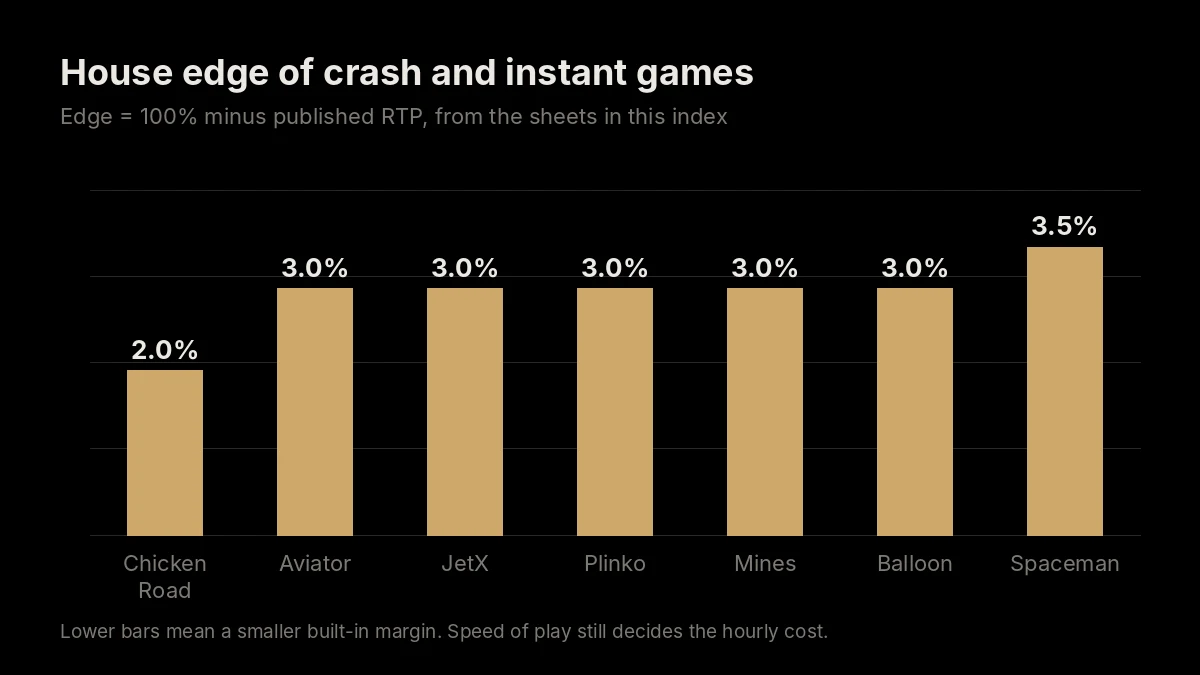
Why the cash-out target does not move the RTP
The most common belief about crash games is that a clever cash-out point can beat the published return. It cannot, because the game is built so that every target carries the same expected value. A crash game with a 97% return pays back 97 units for every 100 staked over the long run whether the player always cashes out at 1.2x or always waits for 10x, and the only thing the target changes is how often wins arrive and how large they are.
Crash game arithmetic with a fixed target
In a game designed around a 97% return, the probability that a round reaches a multiplier m is roughly 0.97 divided by m. A target of 2x is therefore reached in about 48.5% of rounds and pays double the stake, which averages out at 0.97 of the stake. A target of 10x is reached in about 9.7% of rounds and pays ten times the stake, again averaging 0.97. The same holds for any target, which is why the house edge stays at 3% whatever setting is chosen, and why history panels full of early crashes predict nothing about the next round.
Low targets and high targets compared
A low target such as 1.3x produces long sequences of small wins broken by single losses that cancel several of them, so a session feels steady until it suddenly is not. A high target produces many losses in a row and occasional large wins. Neither pattern is better in expected terms. The difference matters for budgeting, because high targets need a larger bankroll to survive the losing runs, while low targets tempt players into raising stakes after a streak of small successes.
High RTP on crash games versus speed of play
A 3% edge is smaller than the margin on most slots, but crash rounds are short and many games allow two bets at once and automatic play. The total amount staked per hour, not the edge alone, decides how much a session costs on average. The factors that push the hourly cost of a crash game above that of a slow table game are mostly about tempo rather than odds:
- rounds that last only a few seconds once the betting window closes;
- two simultaneous bets per round on titles such as Aviator;
- auto bet settings that repeat the stake without any pause;
- auto cash-out options that make each round require no attention at all.
Each of these features is legitimate, optional and clearly described in the game rules, but together they can multiply the number of bets placed in an hour several times over compared with manual play, and the expected loss grows in exact proportion to the number of bets, whatever the published return.
Rounds per hour on crash games
If a round, including the betting window, takes around 15 seconds, an hour holds about 240 rounds. At a stake of 1 unit and a 3% edge, the expected cost is about 7.2 units per hour with one bet, or 14.4 units with two. A slot spinning every 3 seconds at a 4% edge would cost around 48 units for the same stake, so crash games are not always the more expensive choice, but the gap closes quickly once auto bet and double positions are used, and it disappears entirely when stakes are raised to chase a loss.
Auto cash-out and two bets
Auto cash-out removes the reaction-time element but changes nothing in the maths, since the multiplier at which the bet closes is fixed in advance and carries the same 97% expectation as any other. Two bets with different targets simply combine two independent positions with the same edge. Players often pair a safe 1.5x bet with a speculative 10x bet, which smooths the session slightly while doubling the amount staked per round and therefore the hourly cost, without improving the average outcome of either bet.
Adjustable risk games such as Plinko, Mines and Chicken Road
Some instant games replace the rising multiplier with settings chosen before the round starts. In Plinko the player selects the number of rows and a risk level, in Mines the number of hidden mines on a 5x5 grid, and in Chicken Road a difficulty level. These settings reshape the distribution of results, from frequent small returns to rare large ones, while the published return stays fixed, which is why the sheets in this index describe their volatility as adjustable rather than high or low.
Rows, mines and difficulty settings
Raising the risk level in Plinko, or adding rows, moves more of the payout into the outer slots of the board, so most drops return less than the stake and a few return a large multiple. Adding mines in Mines raises the multiplier for each safe tile and lowers the chance of revealing it. The Plinko RTP sheet lists the published figure for the game, and the guide to Plinko rows and risk levels explains how each setting changes the shape of the results without moving the long-run average or the house edge.
Why 98% is not a strategy
Chicken Road publishes 98%, the highest figure among the crash and instant games in this index, which means a house edge of 2% instead of 3%. Over 1,000 units staked, that is an expected cost of 20 units against 30, a genuine difference but a small one next to the effect of bet size and pace. The higher figure applies only if the operator runs the standard configuration, and the game's own panel is the place where the active return is confirmed before any stake is placed in a session.
Cash or Crash RTP and live game shows
Cash or Crash is a live game show from Evolution launched in 2021, in which a presenter draws balls that move a player up a ladder of multipliers until a red ball ends the run or the player takes the money. Evolution described it as having a 99.6% payback when played optimally, which places it above every title in the table, but that figure depends on the player making the best decision at each step rather than following instinct, and any departure from the optimal choices lowers the return actually achieved.
The same principle runs through all live shows: the headline return is a theoretical maximum for perfect play or the best bet spot, and the average player receives less. Live formats are also slower than crash games, with fewer rounds per hour, which lowers the hourly cost even where the edge is similar. The live casino game index lists the published figures for the Evolution titles covered on this site.
Provably fair checks and what they prove
Many crash games, including Spribe's titles, use a provably fair system that lets players confirm that each result was fixed before bets closed. The round outcome is generated from a server seed, whose hashed version is published in advance, combined with client seeds from players, and anyone can recompute the result after the round. Checking a past round in a game that supports this takes only a few steps:
- open the round history and select the round to verify;
- copy the revealed server seed and the client seeds listed for that round;
- confirm that the hash of the server seed matches the one shown before the round;
- recompute the result with the published method or the built-in verifier;
- compare the calculated multiplier with the one displayed in the game.
A successful check proves that the round was not altered after bets closed. It says nothing about whether a website is running the genuine game, whether withdrawals are paid or whether the published return is the active one, so it complements a licence check rather than replacing it, and fake copies of popular games may show a verification panel that proves nothing.